

Uncovering the Past
HERCULANEUM, Italy — A modern scroll has been created and sacrificed in fire to unlock the secrets of the past.
Nearly two thousand years ago, the eruption of Mount Vesuvius buried a Roman library and transformed hundreds of its papyrus scrolls into brittle cylinders of charcoal. Opening many of them would destroy the very words scholars hope to recover.
In a new study published in PLOS ONE, an international team reports that a laboratory-made carbonized papyrus scroll can be virtually opened and read using X-ray tomography. More importantly, their experiment suggests that traces of lead in ancient ink could help researchers identify which of Herculaneum’s still-unopened scrolls offer the best chance of revealing their contents.
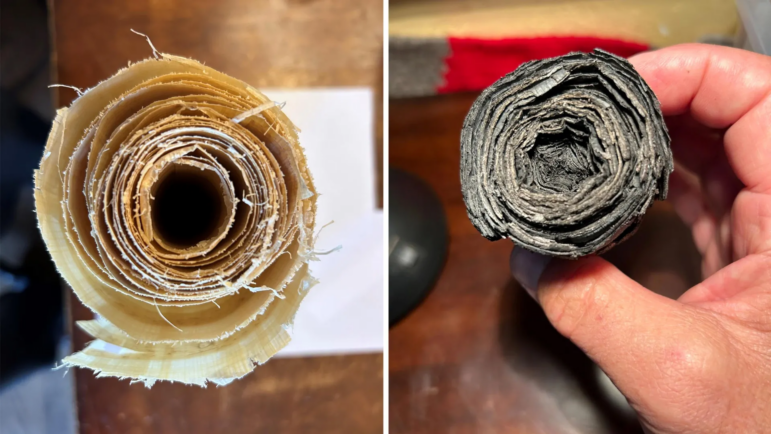
Carbonized scroll produced with tight packing of layers and waviness in an oxygen-free environment via PLOS Credit: Seiler et al., 2026.
The study, “A model carbonized papyrus scroll opens a novel path to identifying readable scrolls of the Herculaneum Library,” led by Douglas Seiler and colleagues, addresses one of the central challenges facing researchers working with the surviving Herculaneum papyri: how to see writing on material that has been carbonized almost beyond recognition.
The scrolls were buried and carbonized during the eruption of Vesuvius in 79 CE. The heat that made them extraordinarily fragile also helped preserve texts that otherwise might have disappeared entirely.
Modern imaging has increasingly allowed researchers to examine the scrolls without physically opening them. Recent efforts have combined high-resolution X-ray tomography with computational techniques to virtually unwrap their tightly compressed layers and identify writing.
But there is a fundamental problem: ancient ink was commonly made from carbon black produced from materials such as soot or charcoal. Papyrus is itself an organic material. After both have been carbonized, researchers are essentially trying to distinguish carbon-based ink from the carbonized surface beneath it. Their X-ray absorption characteristics can be so similar that the writing becomes extraordinarily difficult to detect.
Lead may provide a way around that problem.
Previous examinations of Herculaneum papyri have found traces of lead in some ancient inks. Because lead interacts with X-rays very differently from carbon, researchers wanted to determine whether it could make writing more readily visible and whether scrolls containing it could be identified before undergoing more extensive imaging.
To test the idea without risking irreplaceable ancient manuscripts, the team created its own scroll.
Researchers wrote on modern Egyptian papyrus using reed styluses and carbon-based inks containing different concentrations of lead nitrate. They then rolled the papyrus and subjected it to controlled heating, deliberately carbonizing the scroll to reproduce some of the physical characteristics of the Herculaneum papyri.
The sacrificial scroll could then undergo tests that would be impossible to perform freely on the ancient originals.
Using X-ray micro-tomography and virtual unrolling techniques, researchers successfully recovered the writing. The lead produced greater contrast between the ink and carbonized papyrus, making the letters considerably easier to distinguish.
The team also found that lead could be detected using a portable X-ray fluorescence, or XRF, device. That finding could have practical consequences for the hundreds of Herculaneum papyri awaiting further study.

Mount Vesuvius seen from the Temple of Jupiter. Photo Credit: Andres Alvarado – CC BY-SA 2.0 Flickr
Rather than immediately transporting scrolls for expensive and limited imaging at specialized synchrotron facilities, researchers could first screen them for lead. Scrolls showing stronger lead signatures could then be prioritized as candidates more likely to produce readable text.
“A tuned XRF device could be used to sort scrolls and determine ones with lead content before they are shipped to synchrotron facilities,” the researchers wrote.
The model scrolls offer another advantage: researchers know exactly what was written on them before they were burned. That provides a reference against which computational methods for detecting and reconstructing writing can be tested without placing the ancient papyri at risk.
“There has been recent success in reading these rolls, but they still present problems,” the researchers noted. Creating model scrolls with different ink compositions, they added, provides “a low-risk method to develop algorithms without endangering the priceless artifacts.”
The experiment does not mean every unopened Herculaneum scroll will suddenly become readable. Scrolls written entirely in carbon-based ink remain much more difficult, and the presence and concentration of lead varies among ancient inks.
But the experiment offers researchers something they have not previously had: a comparatively simple way to identify manuscripts that may surrender their words more readily.
Nearly two millennia after Vesuvius burned and buried the library, researchers deliberately burned another scroll.
This time, fire may be the element that helps the lost words emerge.
The Wild Hunt is not responsible for links to external content.
To join a conversation on this post:
Visit our The Wild Hunt subreddit! Point your favorite browser to https://www.reddit.com/r/The_Wild_Hunt_News/, then click “JOIN”. Make sure to click the bell, too, to be notified of new articles posted to our subreddit.