
BRISTOL, England — The Order of Bards, Ovates and Druids (OBOD) has conferred two of its most significant distinctions upon Professor Ronald Hutton, honoring a scholar whose work has helped transform both the academic study and public understanding of Paganism, witchcraft, and Druidry.
During a recent Order gathering, Hutton received the title of Ollamh, one of the rarest honors bestowed by OBOD. Rooted in the Gaelic world, the title traditionally denoted a master scholar, poet, historian, and keeper of wisdom. In a separate presentation, Hutton was also named the first recipient of the newly created Fellowship of the Order of Bards, Ovates and Druids, an honor established to recognize exceptional contributions to the living tradition of Druidry itself.
The dual recognitions reflect Hutton’s unusual position at the intersection of scholarship and practice. Through decades of scholarship, teaching, and community engagement, he has helped foster a productive dialogue between academic research and lived spiritual practice.
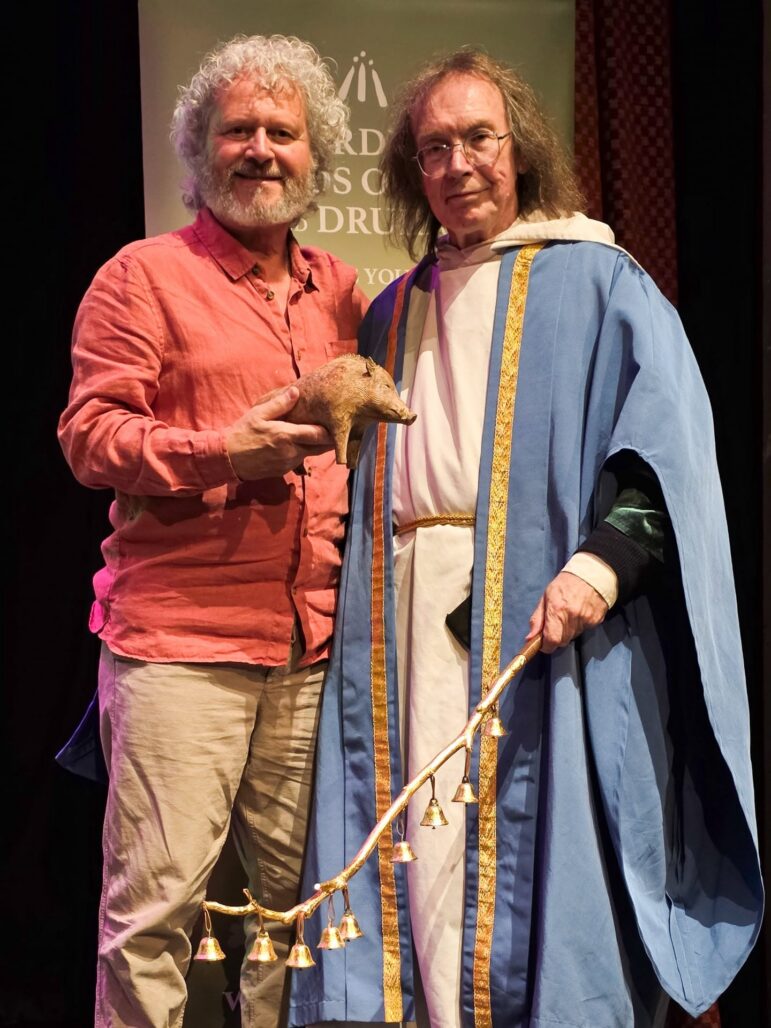
Philip Carr-Gomm and Prof. Ronald Hutton Image via OBOD/Facebook
A professor of history at the University of Bristol and currently Gresham Professor of Divinity, Hutton has spent decades researching the religious, cultural, and folkloric history of Britain and Europe. His work has focused on subjects often neglected or misunderstood within mainstream historical scholarship, including pre-Christian religions, seasonal customs, witchcraft beliefs, folklore, and the development of modern Pagan traditions.
Among his most influential publications is The Pagan Religions of the Ancient British Isles (1991), a landmark synthesis of archaeological, historical, and folkloric evidence relating to pre-Christian religious traditions in Britain and Ireland. The book remains one of the most widely cited works on the subject.
His 1999 volume, The Triumph of the Moon: A History of Modern Pagan Witchcraft, is widely regarded as a foundational text in Pagan Studies. By carefully documenting the historical development of modern Pagan Witchcraft and Wicca, Hutton helped establish the study of contemporary Paganism as a legitimate field of academic inquiry. The book challenged both critics and practitioners to engage more deeply with the historical record while affirming the importance of modern Pagan religions as authentic spiritual movements.
Hutton has also made major contributions to the historical study of witchcraft more broadly. His 2017 book, The Witch: A History of Fear, from Ancient Times to the Present, examined the global development of witch beliefs and witch persecutions across cultures and centuries, tracing recurring themes of fear, magic, and social anxiety while exploring why the figure of the witch has remained such a powerful presence in human imagination. Together, these works have helped shape contemporary scholarly understanding of both historical witch beliefs and modern Pagan practice.
For Druids in particular, Hutton’s contributions have been especially significant. Through works such as The Druids and Blood and Mistletoe: The History of the Druids in Britain, he traced the evolving image of the Druid from the ancient world to the present day. Rather than presenting Druids as figures frozen in antiquity, Hutton demonstrated how successive generations, including Roman writers, antiquarians, poets, nationalists, occultists, archaeologists, and contemporary spiritual seekers, have continually reimagined and reinterpreted Druidry. Other influential works include The Stations of the Sun, his landmark study of the ritual year and seasonal customs in Britain.
In presenting the Ollamh award, OBOD leaders praised not only the breadth of Hutton’s scholarship but also the spirit in which it has been offered. The citation described his work as “rigorous without cynicism, critical without hostility, and deeply humane throughout,” noting that he has consistently approached modern Pagans and Druids with respect while maintaining the highest academic standards.

Awen
Presenting the award, Eimear said the Order wished to honor not only the scholar but also “the man who has served this Order faithfully and generously for decades.”
The award also recognized Hutton’s longstanding service to the Order. A member of OBOD for decades, he has led the Dobunni Grove and has regularly contributed lectures, workshops, presentations, and educational programs at Order camps and gatherings for more than thirty years. According to the citation, generations of members have benefited from his learning, humor, warmth, and generosity.
The newly established Fellowship highlights a different aspect of Hutton’s legacy. While OBOD already recognizes scholarly and artistic achievements through honors such as the Mount Haemus Award and Honorary Bardships, the Fellowship was created specifically to acknowledge extraordinary service to Druidry itself. In remarks accompanying the award, OBOD founder and Chosen Chief, Philip Carr-Gomm noted that Hutton was already the first Mount Haemus Scholar and now an Ollamh, making the Fellowship a third distinction recognizing his influence on the Order and the wider Druid community.
Carr-Gomm credited Hutton with helping modern Druidry mature through careful scholarship and a willingness to question assumptions. “Until Ronald sank his teeth—or perhaps his beak or talons—into Druidry,” Carr-Gomm remarked, “an understanding of its history was quite hopeless: filled with speculation, marred by forgery and fantasy.”
While not always confirming popular narratives, Hutton’s research has provided practitioners with a more historically grounded understanding of their traditions. Carr-Gomm argued that this willingness to combine sympathy with critical inquiry has strengthened rather than weakened the movement. “He helped us to grow up,” he said. “He has helped modern Druidry to mature, to come of age. And we are all profoundly richer because of it.”
Stephanie Carr-Gomm compared Hutton to the Wild Boar of Celtic tradition, praising his willingness to challenge academic conventions and open new avenues for the study of Paganism and Druidry. “You have drawn on this power to confront the inertia and conservatism of academia to forge a path for yourself and others, which—thanks to you—we now follow,” she said before presenting him with a wild boar sculpture commissioned for the occasion.
The honors follow another major recognition in recent years. In 2023, Hutton was appointed a Commander of the Order of the British Empire (CBE) in King Charles III’s New Year Honours for services to history. The award acknowledged a career that has reshaped scholarly understanding of Britain’s religious past and brought greater public awareness to the study of Paganism, folklore, and cultural history.
For many within the Pagan and Druid communities, Hutton’s significance extends beyond his publications and formal accolades. Through decades of scholarship, teaching, and community engagement, he has helped build a bridge between academic research and lived spiritual practice. By naming him both Ollamh and the first Fellow of the Order, OBOD recognized a lifetime devoted not only to understanding Druidry and Paganism, but also to helping those traditions better understand themselves.
Closing the presentation, Eimear thanked Hutton for “your scholarship, your integrity, your friendship, your humour, and your lifelong dedication to the preservation and illumination of these traditions.”
The Wild Hunt is not responsible for links to external content.
To join a conversation on this post:
Visit our The Wild Hunt subreddit! Point your favorite browser to https://www.reddit.com/r/The_Wild_Hunt_News/, then click “JOIN”. Make sure to click the bell, too, to be notified of new articles posted to our subreddit.