
WASHINGTON — The U.S. Supreme Court has issued a decision in Landor v. Louisiana Department of Corrections and Public Safety, leaving intact a significant limitation on enforcement of the federal Religious Land Use and Institutionalized Persons Act (RLUIPA). Prisoners may seek prospective relief against state officials or pursue other legal avenues, but they generally cannot recover personal-capacity damages from state prison employees under RLUIPA alone. The Court heard oral arguments on Nov. 10, 2025, and released its decision today.
The case involves Damon Landor, a devout Rastafarian whose long dreadlocks were forcibly shorn by prison guards in 2020, by order of the prison warden just three weeks before his scheduled release. According to court records, prison officials forcibly shaved Landor’s dreadlocks despite being presented with a federal appeals court ruling recognizing the religious protection of Rastafarian hair practices.
Landor claimed that the warden’s order violated both a standing judicial ruling and the federal Religious Land Use and Institutionalized Persons Act (RLUIPA), which forbids the government from imposing “substantial burdens” on the religious practices of incarcerated people.
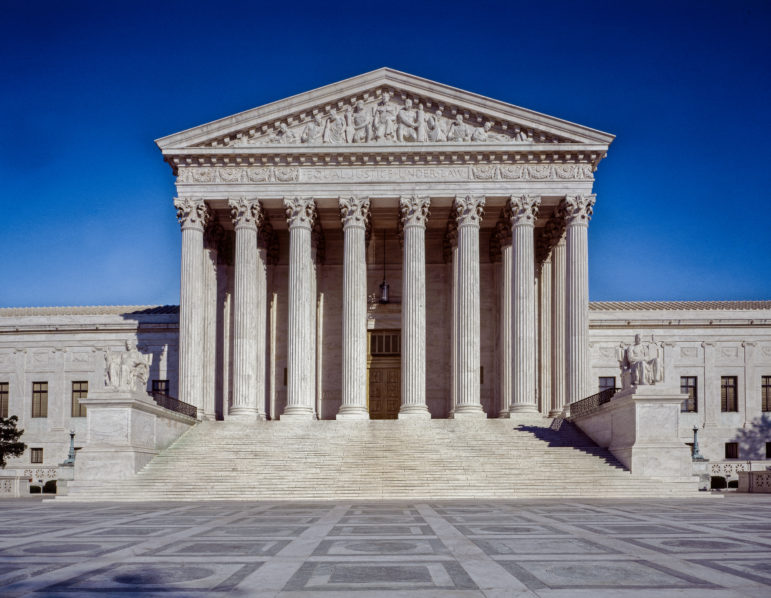
United States Supreme Court Building By Carol M. Highsmith – Library of Congress Catalog: http://lccn.loc.gov/2011631106Image download: https://cdn.loc.gov/master/pnp/highsm/12900/12912a.tifOriginal url: http://hdl.loc.gov/loc.pnp/highsm.12912, Public Domain, https://commons.wikimedia.org/w/index.php?curid=91285025
Landor is a Rastafarian, a member of a syncretic faith that originated in Jamaica in the 1930s and blends biblical teachings with Afro-Caribbean spirituality. The religion is perhaps best known for its ritual use of cannabis (ganja) as a sacrament to aid meditation and connection with the divine; the distinctive plant-based Ital diet, emphasizing natural, unprocessed foods; and the Nazarite vow, a sacred commitment not to cut one’s hair, symbolizing spiritual strength and divine covenant.

Rastafari often identify with the flag of the Ethiopian Royal Standard used during Haile Selassie’s reign.
For nearly twenty years, Landor had honored his Nazarite vow. He had served most of his sentence in two Louisiana prisons that respected this observance, even allowing him to wear his hair under a “rastacap.” But when transferred to Raymond Laborde Correctional Center, Landor’s dreadlocks were cut off after he presented officers with a copy of the federal appeals court ruling affirming his right to keep them. According to court filings, guards handcuffed Landor to a chair, ignored the order, and shaved his head bald.
After completing his sentence, Landor sued for monetary damages, arguing that his constitutional and statutory rights had been flagrantly violated. Louisiana later revised its grooming policy, but that change did not resolve the question of whether damages were available under RLUIPA. Indeed, lower courts condemned Landor’s treatment but held that RLUIPA does not authorize individual-capacity damages against state officials. That was the question before the Supreme Court: whether individual officers can be sued under RLUIPA for violating an inmate’s religious freedom. In a 6–3 decision, the Court answered no.
Landor’s case highlights how U.S. religious freedom laws, more often tested by Christians, are increasingly applied to diverse minority traditions. Christians represent roughly 62 percent of the U.S. population, while 7 percent belong to other faiths and 29 percent identify with none.
The forced cutting of dreadlocks, Landor’s attorney Zachary Tripp told the justices, was a “brazenly illegal assault” and “the poster child for a RLUIPA violation.” The law, passed in 2000, was designed to protect inmates’ ability to practice religion freely even under the constraints of incarceration. Yet Landor argued that the promise of protection is incomplete without a meaningful remedy when violations occur.

Image credit: Blogtrepreneur – CC BY 2.0, https://commons.wikimedia.org/w/index.php?curid=50979400
Writing for the majority, Justice Neil Gorsuch concluded that RLUIPA, which was enacted under Congress’s Spending Clause authority, functions as a condition attached to federal funding received by state prison systems. Because the Louisiana Department of Corrections voluntarily accepted those conditions, it is subject to obligations imposed by the statute. However, Gorsuch wrote that individual prison employees never personally agreed to those funding conditions and therefore cannot be sued for damages in their individual capacities. The Court held that Spending Clause statutes may impose liability only on parties that have “voluntarily and knowingly” consented to such obligations.
The majority rejected arguments that prison employees could be treated as indirect recipients of federal funds or as agents bound by the state’s agreement with the federal government. It also dismissed comparisons to other federal statutes and declined to extend a previous ruling that allowed damages claims against federal officials under the Religious Freedom Restoration Act (RFRA).
During oral arguments, Justices Ketanji Brown Jackson and Elena Kagan signaled sympathy for Landor’s claim. Jackson argued that prison officials were clearly subject to RLUIPA as part of their employment, while Kagan compared the situation to lawsuits under Section 1983, which routinely allow damages against state officials who violate constitutional rights.
Justice Ketanji Brown Jackson, joined by Justices Sonia Sotomayor and Elena Kagan, dissented. Jackson argued that RLUIPA’s text plainly authorizes suits against individual officials and that the majority improperly transformed a federal civil-rights statute into a contractual arrangement. She warned that the decision leaves many prisoners without an effective remedy when their religious rights are violated and weakens Congress’s ability to enforce protections enacted under its spending power.
The decision affirms the Fifth Circuit and leaves intact a significant limitation on RLUIPA enforcement: prisoners may seek prospective relief against state officials or pursue other legal avenues, but they generally cannot recover personal-capacity damages from state prison employees under RLUIPA alone.
While the case centered on a Rastafarian inmate, the ruling has broader implications for all minority faith practitioners in correctional settings, especially those religions whose practices may require accommodations that depend on prison officials’ compliance with federal religious-liberty protections.
Beyond the technical questions of statutory interpretation, Landor v. Louisiana raises broader questions about the practical enforceability of religious-liberty protections in correctional settings. The ruling may be especially significant for adherents of minority religions, whose faith practices often depend on institutional accommodations that can be difficult to enforce once a violation has already occurred.
While prisoners may still seek injunctive relief and may have other constitutional or state-law claims available to them, the Court’s ruling removes one potential avenue for holding individual prison officials personally liable under RLUIPA. As Landor’s counsel argued during oral arguments, protections without meaningful remedies risk existing only “on paper.”
The Wild Hunt is not responsible for links to external content.
To join a conversation on this post:
Visit our The Wild Hunt subreddit! Point your favorite browser to https://www.reddit.com/r/The_Wild_Hunt_News/, then click “JOIN”. Make sure to click the bell, too, to be notified of new articles posted to our subreddit.