

HEIDELBERG, Germany – Researchers at Heidelberg University announced last week that they have deciphered a “curse tablet” dated to the second century C.E. The tablet was excavated from a military outpost of the Roman Empire, but was written in Greek rather than Latin and is written in a style associated with Roman-era Egypt. Taken as a whole, the object displays the intersections of different cultures and their conceptions of magic in the Roman Empire.
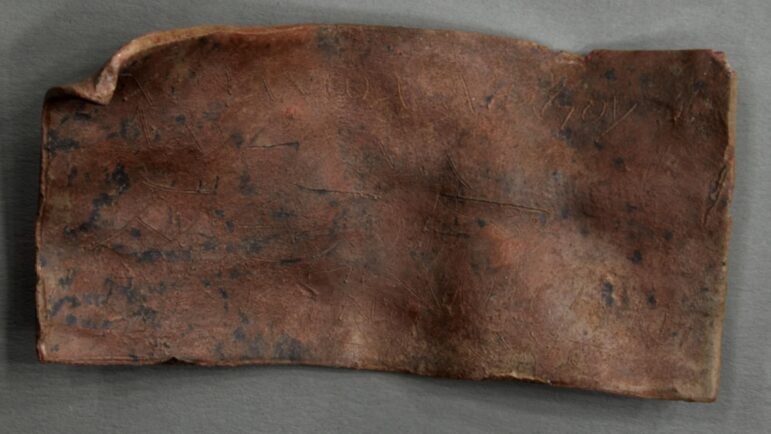
Heerlen curse tablet with an ancient Greek invocation of deities and demons in the Egyptian style. | © Elke Fuchs, Institut für Papyrologie, Universität Heidelberg
Curse tablets, known in Latin as tabella defixionis and Greek as katadesmos, were generally thin sheets of lead on which were inscribed invocations to deities and spirits to perform actions on the object of the curse. The “curses” could include a variety of effects, from the straightforward punishment or hindrance of the target, to love spells fueled by sympathetic magic, to even calling on spirits to aid the deceased. The curse tablets were often rolled up and pierced with nails and sometimes were used in conjunction with dolls made to look like their targets. More than 2000 curse tablets have been discovered across the former Roman Empire.
This particular curse tablet was excavated the town square of a Roman military settlement called Coriovallum, now modern Heerlen in The Netherlands. Archeologists used a technique called “reflectance transformation imaging,” or RTI, to take multiple photographs of the inscriptions on the tablet, which can then be digitally combined to create a single image whose lighting can be dynamically adjusted to show even minute features. RTI showed the tablet had three distinct groups of characters inscribed on its surface.
“What is particularly noteworthy about the tablet,” Heidelberg University said in a statement, “is the invocation of various deities and demons in the Egyptian style, composed in ancient Greek, since most curse tablets found in Northern Europe are written in Latin.
“In addition,” the statement continues, “the Heerlen curse tablet contains a group of three magical symbols, known as ‘Characteres.’ According to [Rodney Ast, Academic Director at the Institute for Papyrology] these were likely used to convey the desired message to the supernatural powers. They are followed by the names of two men and two women, who are referred to as fellow slaves.”
The names are themselves interesting, as two indicate men with Latin names and the other two are Greek names belonging to women. According to Heidelberg University’s Institute for Papyrology’s Julia Lougovaya, it’s possible that one of the women was the author of the inscription and brought her knowledge of magical communication with gods and spirits from Roman Egypt.
“The tablet served either as a curse against these four slaves or as a curse in their name against an unnamed person,” according to Ast.
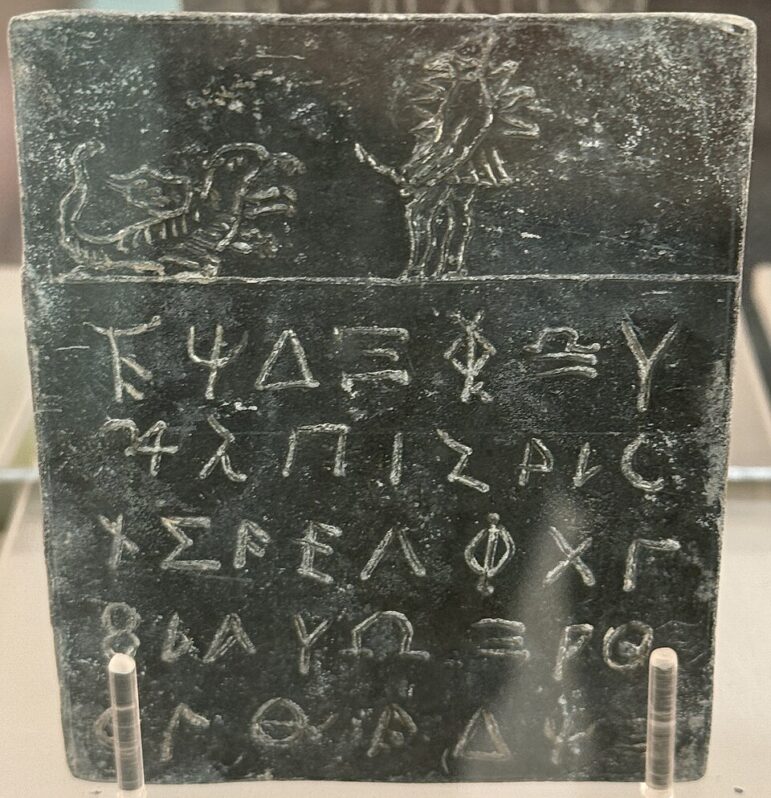
Ancient roman lead tablet inscribed with a curse, from the Baths of Diocletian in Rome [Bari’ bin Farangi, Wikimedia Commons, CC 4.0]
Although the exact contents of the curse tablet have not been published as yet, the details that have been provided demonstrate just how far-ranging the networks of communication and influence were during the Roman Empire, as an object from a primarily Latin magical tradition, written in Greek under Egyptian influence, found its way to the far north of the Empire. It also speaks to how the fundamental role magic played in the lives of those living in Roman society.
“In the early centuries A.D., Near Eastern, Egyptian, Jewish, and sometimes even Christian traditions increasingly merged and spread throughout the entire Roman Empire of that time – a development that the discovery from Heerlen impressively underscores,” said Joachim Quack, Director of the Institute for Egyptology at Heidelberg University.
The tablet will be displayed in the future at Heerlen Museum, and the inscription will be included in a forthcoming scholarly publication.
The Wild Hunt is not responsible for links to external content.
To join a conversation on this post:
Visit our The Wild Hunt subreddit! Point your favorite browser to https://www.reddit.com/r/The_Wild_Hunt_News/, then click “JOIN”. Make sure to click the bell, too, to be notified of new articles posted to our subreddit.