
WASHINGTON, D.C. — “Transgenderism, same-sex marriage, opening women’s locker rooms to men are just the tip of the iceberg,” Evangelical preacher Franklin Graham told attendees at the “Rededicate 250” event held on the National Mall this past weekend. His remarks suggested that broader cultural and political battles remain ahead.
The gathering, organized by Freedom 250, was described by organizers as a “National Jubilee of Prayer, Praise and Thanksgiving” ahead of the United States’ 250th anniversary. The event, organized through the Freedom 250 initiative in coordination with the White House Task Force 250, drew criticism from church-state separation advocates and interfaith organizations who argued that it blurred the line between religion and government. The combination of Christian worship, nationalist imagery, and participation by senior government officials prompted critics to characterize the gathering as an example of growing Christian nationalist influence in American public life.
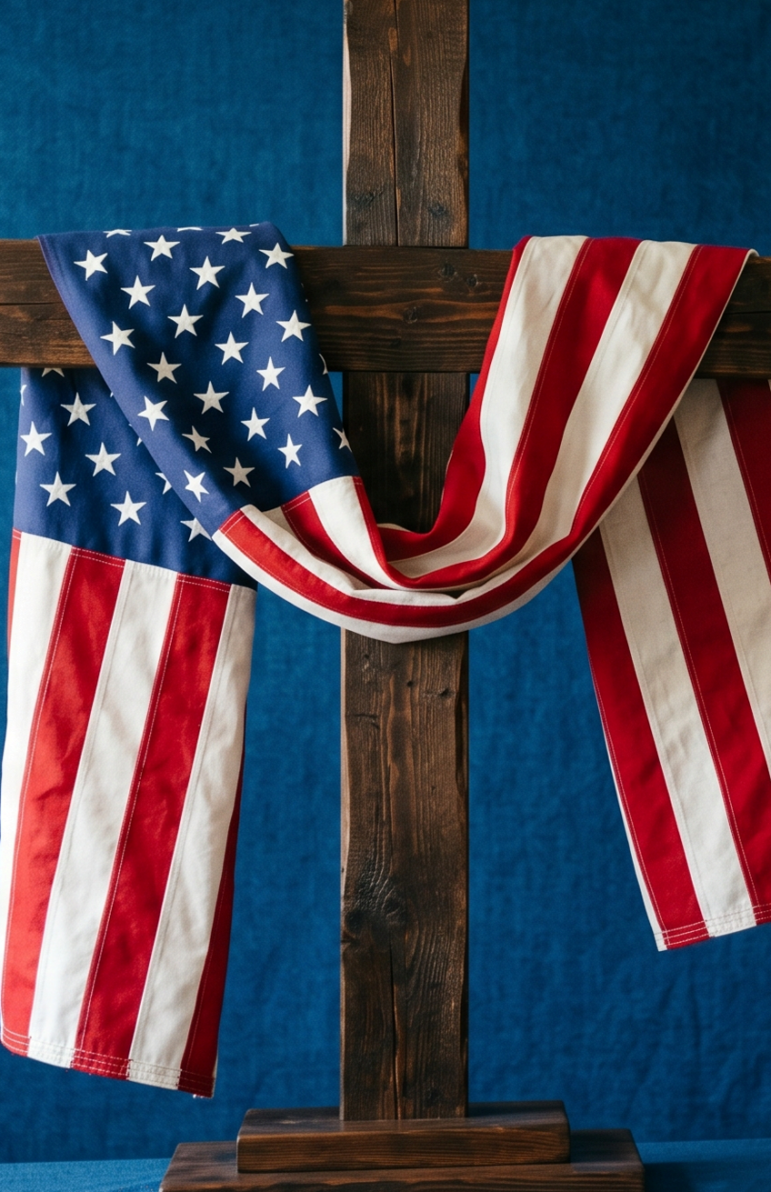
Cross with American flag at local church event. [MJTM
With the Washington Monument in the background and clear views of the U.S. Capitol, worship music played from a stage designed to emphasize the event’s Christian identity. Arched stained-glass-style panels beneath large columns modeled after federal architecture depicted the nation’s founders alongside a white cross. The event lasted more than eight hours and featured worship music, appearances by religious leaders, and speeches from members of the Trump administration.
Tim Scott drew cheers from the audience when he shouted into the microphone, “Are you a believer in Jesus?!” Video presentations at the event also included President Donald Trump reading from 2 Chronicles during a separate “America Reads the Bible” event held last month. Trump quoted the verse, “If my people, which are called by my name, shall humble themselves, and pray, and seek my face, and turn from their wicked ways; then will I hear from heaven, and will forgive their sin, and will heal their land.”
Defense Secretary Pete Hegseth referenced the long-circulating story of George Washington “praying without ceasing” during the Revolutionary War while troops suffered through the winter at Valley Forge. “Let us pray as he did,” Hegseth said. “Let us pray without ceasing. Let us pray for our nation on bended knee.”
The image of Washington as a deeply devotional figure constantly engaged in prayer is widely regarded by historians as more legend than documented historical fact. Washington was formally affiliated with the Episcopal Church and frequently spoke about “Providence,” but historians generally describe him as reserved and private about his personal faith, reluctant to discuss Jesus Christ explicitly, and more focused on morality, civic virtue, and public religion than overt theology. Unlike many modern evangelical leaders, Washington rarely wrote or spoke about salvation, being “born again,” biblical literalism, or emotional conversion experiences.
Secretary of State Marco Rubio emphasized what he described as the historic relationship between Christianity and the founding of the United States. Rubio contrasted Christianity with what he described as pre-Christian “pagan societies.” He argued that Western concepts of freedom, dignity, and moral responsibility emerged primarily from Christian civilization, a claim disputed by many historians and scholars of religion. He also connected American westward expansion, the Apollo-era moon landings, and NASA’s recent Artemis missions to faith and divine guidance. “The soul of our nation has always been rooted in an ancient faith,” Rubio said.
Rubio has previously framed modern secularism and contemporary social movements as spiritually hostile forces comparable to ancient paganism. In speeches to conservative Christian audiences, including at Liberty University, Rubio has described Christianity as a “sacred inheritance” under threat from secular culture.
Critics of such rhetoric note that democratic governance itself does not emerge from biblical teaching but instead has significant roots in Hellenic political philosophy and Enlightenment thought, both of which strongly influenced the founders of the United States.
House Speaker Mike Johnson also framed the event as part of a broader spiritual struggle over American identity.
“In recent years we’ve seen sinister ideologies sow confusion and discord among our people,” Johnson said. “We’ve witnessed attacks on our history, on our heroes and the cherished moral and spiritual identity of this great nation.” He criticized perspectives that frame American history primarily through oppression and injustice before concluding, “Father, we reject that. We rebuke it in your name.”
Progressive organizations also organized counter-events around Washington. Among them were the Freedom From Religion Foundation, which advocates for strict separation of church and state, and Faithful America. The groups displayed a large balloon depicting a Trump-like goldenalf near the National Mall, invoking the biblical story of idolatry.
On Thursday evening, the Interfaith Alliance projected protest slogans onto an exterior wall of the National Gallery of Art. One projection read, “Democracy not theocracy,” while another declared, “The separation of church and state is good for both.”
The event also highlighted ongoing tensions between Christian nationalist movements and non-Christian communities.
Among the speakers associated with the broader Christian nationalist movement is Pastor Samuel Rodriguez, president of the National Hispanic Christian Leadership Conference, who has repeatedly characterized Wicca, neo-Paganism, and New Age spirituality as forms of “counterfeit spirituality” incompatible with Christianity. Rodriguez has publicly supported “spiritual warfare” efforts against what he describes as occult influence in American culture.
Rabbi Meir Soloveichik, the lone non-Christian faith leader to speak at the rally, has also written critically about ancient paganism, describing it as a worldview that elevates nature and earthly power into objects of worship. Drawing in part on the work of C. S. Lewis, Soloveichik has argued that societies centered on immanent rather than transcendent understandings of the divine can become spiritually dangerous.
Similarly, Graham and the Billy Graham Evangelistic Association have consistently warned that Wicca and Pagan spiritual practices represent dangerous spiritual deception. The organization frequently cites biblical passages condemning witchcraft and divination, arguing that supernatural practices outside Christianity place individuals in contact with demonic forces rather than divine power. While Graham often frames these warnings in pastoral rather than punitive terms, the rhetoric contributes to a broader religious environment in which Paganism is portrayed as spiritually dangerous or socially corrosive.
Despite the event’s national ambitions and extensive promotion, large sections of the designated seating area remained empty throughout the day. Critics on social media pointed to the unfilled seats as evidence that Freedom 250’s effort to create a mass religious-political mobilization may have fallen short of expectations. Nevertheless, the event conveyed a clear message that segments of evangelical Christianity should play a central role in American political and cultural life.
The Wild Hunt is not responsible for links to external content.
To join a conversation on this post:
Visit our The Wild Hunt subreddit! Point your favorite browser to https://www.reddit.com/r/The_Wild_Hunt_News/, then click “JOIN”. Make sure to click the bell, too, to be notified of new articles posted to our subreddit.