

VATICAN CITY – Pope Leo XIV released a new encyclical this weekend, Magnifica Humanitas (“Magnificent Humanity”), an 80-page teaching document that examines the moral and social implications of artificial intelligence while revisiting longstanding Catholic concerns about labor, slavery, war, and human dignity. The encyclical largely looks toward the future, using AI as an entry point to address broader questions about economic justice, technological power, and what it means to remain fully human in an increasingly automated age.
Signed on the anniversary of Rerum Novarum, Pope Leo XIII’s landmark 1891 encyclical on labor during the Industrial Revolution, the document frames artificial intelligence as one of the defining challenges of a new technological era. Leo even invokes J. R. R. Tolkien through a quotation spoken by Gandalf to Frodo: “It is not our part to master all the tides of the world, but to do what is in us for the succour of those years wherein we are set, uprooting the evil in the fields that we know, so that those who live after may have clean earth to till.”
While acknowledging AI as a potentially valuable tool, Leo underscores that it remains fundamentally different from humanity. AI systems may imitate intelligence and surpass humans in computational speed, but they do not experience relationships, suffering, responsibility, or moral conscience. The pope warns against confusing technological capability with human wisdom.
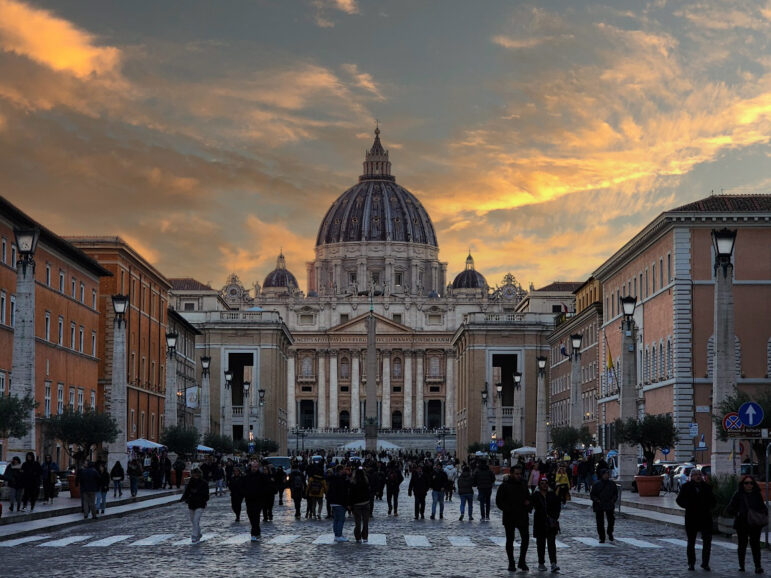
The Papal Basilica of Saint Peter in the Vatican [Photo Credit: Stefano Ciotti 2024
A major focus of the encyclical is labor. Leo argues that automation and efficiency must never override the dignity of workers, fair wages, or meaningful participation in society. He condemns exploitative labor tied to the digital economy, including dangerous mineral extraction, poorly paid data labeling, and psychologically harmful content moderation work. Addressing what he called “new forms of slavery,” Leo also acknowledged the Catholic Church’s delayed condemnation of the slave trade.
The encyclical further warns against concentrating technological power in the hands of elites, comparing unchecked technological ambition to the biblical Tower of Babel. It calls for humility, diversity, and protections for vulnerable populations, especially children and workers.
The document drew praise from Anthropic co-founder Chris Olah, who thanked the pope for raising ethical concerns about AI and admitted researchers continue to encounter “mysterious” and “unsettling” behaviors in advanced systems. Olah noted that researchers “keep finding things that are mysterious, even unsettling,” including evidence that some systems appear to engage independent thinking and project states that “functionally mirror joy, satisfaction, fear, grief and unease.”
What may be overlooked in the immediate reaction to Magnifica Humanitas is the opportunity it presents for broader interfaith dialogue. While the encyclical is unmistakably rooted in Catholic theology and social teaching, many of its central concerns will sound surprisingly familiar to Pagans, Wiccans, and other earth-centered spiritual communities.
The document repeatedly warns against systems that reduce human beings to productivity, data, efficiency, or consumption. It criticizes concentrations of political, economic, and technological power that weaken communities and diminish human dignity.
Many contemporary Pagan perspectives share those views, particularly traditions that emphasize a reverence for interconnectedness, reciprocity, balance, personal agency, and skepticism toward systems of domination and extraction. The encyclical frames humanity as fundamentally relational; connected to community, labor, the natural world, and moral responsibility. That emphasis on interdependence echoes many animist, Wiccan, and Pagan perspectives that see life as woven into networks of relationship rather than opportunities for commodification.

Flag of Vatican City [public domain
The document is deeply skeptical of systems that concentrate power, whether economic, political, or technological. Many Pagan and Wiccan traditions similarly emphasize balance, reciprocity, and wariness toward hierarchical systems that remove agency from communities or disconnect people from natural and spiritual realities.
The encyclical’s concern about human beings becoming subordinate to systems of productivity and efficiency may resonate strongly with Pagan critiques of industrial modernity.
One of the strongest overlaps may be the insistence that human worth cannot be reduced to output, efficiency, or profit. The statement aligns with eco-spiritual and feminist traditions that stress intrinsic worth, sacred embodiment, and the value of contemplation, ritual, creativity, and community outside capitalist measures of utility.
Although the AI sections focus on labor and technology, the broader encyclical appears aligned with the ecological concerns associated with Pope Francis and Laudato Si’, which included skepticism toward exploitative economics, concern for vulnerable populations,
criticism of consumerism, and warnings against treating nature and people as disposable.
Magnifica’s emphasis on intermediary communities, local responses, solidarity, and participatory social structures may also resonate with the decentralized structures common in modern Paganism.
That said, there are also obvious theological differences.
The encyclical remains explicitly Christological and rooted in Catholic social thought and reasoning. Its understanding of human dignity derives from Christian theology, and it retains Catholic moral frameworks that many polytheists, Pagans, Heathens, and Wiccans would not share.
That does not mean common ground is absent. Magnifica rejects that humans are merely information-processing systems. At the level of social ethics, especially around ecology, anti-exploitation, dignity, and skepticism toward dehumanizing systems, there is considerable overlap. The encyclical’s critique of technological cultures that separate people from relationship, embodiment, and community parallels longstanding Pagan concerns about industrial modernity and disconnection from the natural world.
None of that erases profound theological differences. However, interfaith cooperation has never required doctrinal uniformity. What matters is the recognition of shared ethical concerns.
At a moment when artificial intelligence, surveillance capitalism, environmental degradation, and economic precarity are reshaping human life at an extraordinary speed, Magnifica Humanitas offers something increasingly rare: a moral framework that insists human beings are more than consumers, workers, datasets, or technological problems to be optimized.
It is an invitation to work together and build a future that continues to celebrate humanity. That may be the encyclical’s most important invitation.
The Wild Hunt is not responsible for links to external content.
To join a conversation on this post:
Visit our The Wild Hunt subreddit! Point your favorite browser to https://www.reddit.com/r/The_Wild_Hunt_News/, then click “JOIN”. Make sure to click the bell, too, to be notified of new articles posted to our subreddit.