
WASHINGTON — Across traditions, cannabis has held a place in spiritual practice, joining other psychoactive substances such as psilocybin, peyote, and ayahuasca at the center of rituals intended to alter consciousness, facilitate healing, and deepen connection to the sacred. Within the Rastafari tradition, for example, cannabis is regarded as a sacred herb, used ritually to elevate consciousness, deepen meditation, and foster communal reasoning, placing it at the heart of spiritual practice rather than recreation. Cannabis’ complex relationship with spirituality has also been the subject of litigation, with some practitioners seeking protections under the Religious Freedom Restoration Act, claims that courts have largely declined to extend to cannabis use.
That landscape may be shifting. The Trump administration is expected to take a significant step on federal cannabis policy as soon as this week, potentially initiating the long-anticipated process of reclassifying marijuana under U.S. law. If finalized, the move would mark one of the most consequential shifts in federal drug policy in decades, though its practical effects may be more limited than headlines suggest.
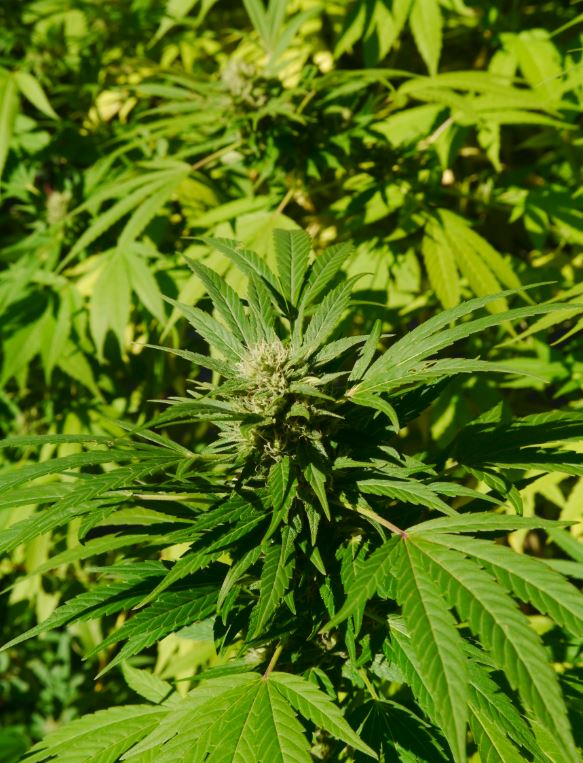
Thayne Tuason [CC BY-SA 4.0 (https://creativecommons.org/licenses/by-sa/4.0)]
Cannabis sativa female- recreational/medicinal marijuana, not hemp credit Thayne Tuason/ Wikimedia
According to multiple reports, including Axios and The Washington Post, administration officials are preparing to advance a plan to move cannabis from Schedule I to Schedule III under the Controlled Substances Act (CSA). This change would place marijuana alongside substances such as ketamine and certain anabolic steroids, drugs recognized as having medical uses but still subject to regulation.
The anticipated action follows an executive order signed by Trump in December 2025, formally titled Increasing Medical Marijuana and Cannabidiol Research. In that directive, the president acknowledged the growing use of cannabis in treating medical conditions and managing pain, while criticizing its longstanding classification as a Schedule I substance, reserved for drugs deemed to have no accepted medical use and a high potential for abuse.
Trump instructed the attorney general to “take all necessary steps” to complete the rulemaking process for rescheduling marijuana. That directive set in motion a complex administrative pathway involving the Department of Justice (DOJ), the Drug Enforcement Administration (DEA), and scientific review processes that had already begun under the prior administration.

Despite the president’s order, progress has been uneven. Trump himself recently expressed frustration, suggesting that officials were “slow-walking” the process. “You’re going to get the rescheduling done, right, please? Will you get the rescheduling done, please?” he said during a recent Oval Office event. “You know, they’re slow-walking me on rescheduling. You’re going to get it done, right?”
Now, that process appears to be nearing a critical juncture. Sources cited by The Washington Post suggest that the Drug Enforcement Administration may announce a new administrative hearing on cannabis rescheduling, reviving a process that was previously halted amid legal challenges. Those earlier proceedings were derailed after allegations of procedural irregularities, including concerns about communications between agency officials and anti-reform witnesses.
Even if the administration proceeds quickly, however, the implications of rescheduling are often misunderstood. Moving cannabis to Schedule III would not legalize marijuana at the federal level, nor would it permit recreational use nationwide. Instead, the change would primarily affect research, taxation, and certain regulatory frameworks.
One of the most immediate impacts would be the removal of significant barriers to scientific study. Under Schedule I, researchers face strict limitations in accessing and studying cannabis, contributing to a longstanding gap between widespread medical use and formal clinical evidence. The proposed reclassification is intended, in part, to close that gap by easing research restrictions.
The shift could also have financial implications for the cannabis industry. Currently, state-legal marijuana businesses are subject to Internal Revenue Service code 280E, which prohibits them from taking standard business deductions because cannabis is classified as a Schedule I substance. Rescheduling would allow these businesses to deduct ordinary expenses, potentially improving profitability and stability in a rapidly expanding sector.
At the same time, the policy change would not override other federal regulatory requirements. For example, cannabis would still need approval from the Food and Drug Administration (FDA) before it could be prescribed as a medication. Similarly, federal workplace rules, particularly in safety-sensitive industries, would continue to impose restrictions.
In some sectors with especially sensitive positions, such as nuclear energy, strict fitness-for-duty standards apply; the distinction between Schedule I and Schedule III could nonetheless carry meaningful consequences. Under current regulations, a positive drug test for a Schedule I substance like marijuana is automatically disqualifying, regardless of state legality or medical authorization.
If cannabis is reclassified, that automatic disqualification would no longer apply. Instead, medical review officers could evaluate whether a positive test reflects legitimate prescribed use and assess any associated safety risks. While this does not guarantee acceptance, it introduces a level of discretion that does not currently exist.
Politically, the issue continues to draw bipartisan interest, though not without skepticism. House Minority Leader Hakeem Jeffries (D- NY) signaled growing legislative momentum, stating that “the votes do exist to act legislatively” on federal marijuana reform and adding, “we’re going to find a way to do so, hopefully in this Congress.”
At the same time, some lawmakers have raised concerns about public health and regulatory impacts. Sen. Ted Budd (R-NC), for example, has pointed to potential risks, arguing that cannabis use is associated with an “increased risk for heart attacks, strokes, psychotic disorders and further addictions.”
Meanwhile, Sen. Cory Booker (D-NJ), a long-time advocate for cannabis reform, urged caution in evaluating the administration’s actions. “The ability of the Trump administration to speak out of both sides of their mouth is staggering,” Booker said. “So I’m just going to wait and see right now. Obviously, there’s things that look promising to end generations of injustice. I really want to wait and see.”
Public opinion, however, appears strongly supportive. Polling cited in recent reports indicates that more than 80 percent of cannabis consumers favor the rescheduling effort, reflecting a broader national shift in attitudes toward marijuana policy.
For now, much depends on the administrative process within the U.S. Department of Justice and the Drug Enforcement Administration. The possibility of new hearings and ongoing litigation means that even an imminent announcement may not represent the final step. If the Trump administration follows through, the decision would signal a notable recalibration of federal drug policy. While stopping short of full legalization, it would acknowledge evolving medical, economic, cultural, and, perhaps most importantly, political realities.
The Wild Hunt is not responsible for links to external content.
To join a conversation on this post:
Visit our The Wild Hunt subreddit! Point your favorite browser to https://www.reddit.com/r/The_Wild_Hunt_News/, then click “JOIN”. Make sure to click the bell, too, to be notified of new articles posted to our subreddit.