
WASHINGTON — The U.S. Supreme Court on Tuesday remanded a case involving a Colorado law banning “conversion therapy” for LGBTQ+ minors, finding that it raises serious First Amendment concerns and must be reconsidered under a more rigorous legal standard.
The issue has divided the lower courts. A federal appeals court in Florida struck down similar local restrictions as unconstitutional, while a split panel of the U.S. Court of Appeals for the 10th Circuit upheld Colorado’s law, concluding that talk therapy by licensed professionals constitutes medical treatment subject to state regulation.
In an 8–1 decision, the Court sided with a Christian licensed counselor who challenged the law, arguing that it unlawfully restricts speech. Writing for the majority, Justice Neil Gorsuch framed the issue narrowly but firmly within constitutional protections for expression.
“The law ‘censors speech based on viewpoint,’” Gorsuch wrote. He emphasized that the First Amendment “stands as a shield against any effort to enforce orthodoxy in thought or speech in this country.”
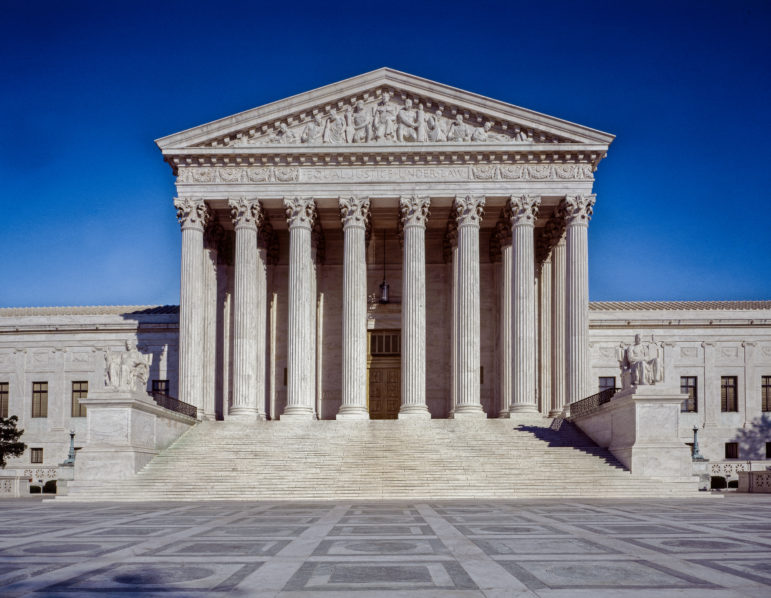
United States Supreme Court Building By Carol M. Highsmith – Library of CongressCatalog: http://lccn.loc.gov/2011631106Image download: https://cdn.loc.gov/master/pnp/highsm/12900/12912a.tifOriginal url: http://hdl.loc.gov/loc.pnp/highsm.12912, Public Domain, https://commons.wikimedia.org/w/index.php?curid=91285025
The ruling does not immediately invalidate Colorado’s ban. Instead, the Court sent the case back to a lower appeals court, directing it to apply a more demanding level of constitutional scrutiny—one that many laws fail to survive. Still, the decision appears to signal deep skepticism among the justices about laws that regulate speech based on its content, even in the context of licensed professional practice.
Notably, the majority opinion drew support from across the Court’s ideological spectrum, including liberal Justices Elena Kagan and Sonia Sotomayor. Their concurrence underscored that the constitutional issue, in their view, was relatively straightforward.
Kagan, joined by Sotomayor, wrote separately to explain that the law impermissibly takes sides in an ongoing public debate. “Because the state has suppressed one side of a debate, while aiding the other, the constitutional issue is straightforward,” she wrote.
At the heart of the case is the distinction between regulating professional conduct and restricting speech. Colorado argued that its law was a standard exercise of its authority to regulate medical professionals, aimed at protecting minors from harmful practices. Major medical associations have long held that efforts to change a person’s sexual orientation or gender identity are ineffective and potentially damaging, particularly for young people.
However, the Court rejected the state’s characterization. Gorsuch wrote that the law “trains directly on the content of her speech and permits her to express some viewpoints but not others,” rather than merely regulating professional conduct.
The counselor at the center of the case, represented by the conservative legal organization Alliance Defending Freedom, argued that the law restricts her ability to engage in talk therapy aligned with her religious beliefs. Importantly, she did not challenge restrictions on physical interventions, focusing instead on verbal counseling.
Gorsuch acknowledged this distinction, noting that “Ms. Chiles does not question that Colorado’s law banning conversion therapy has some constitutionally sound applications.” The issue, he wrote, is whether the law’s application to speech meets the high bar required when First Amendment rights are implicated.
“Every American possesses an inalienable right to think and speak freely, and a faith in the free marketplace of ideas as the best means for discovering truth,” the Court’s opinion said. “However well intentioned, any law that suppresses speech based on viewpoint represents an ‘egregious’ assault on both of those commitments.”
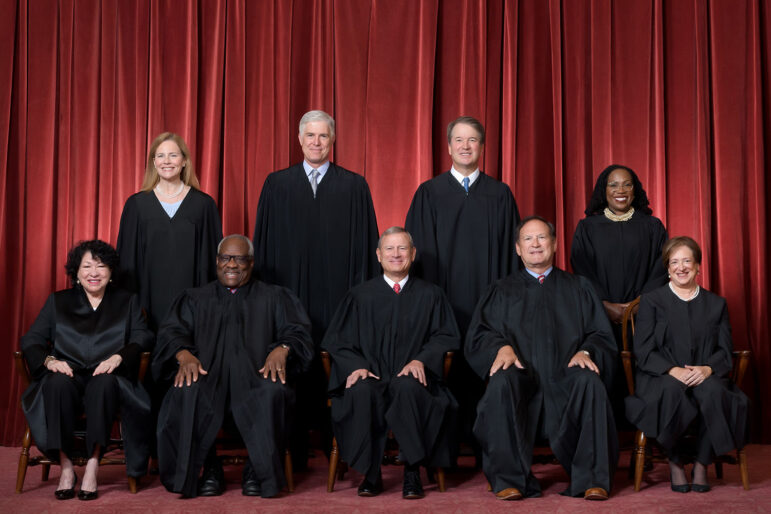
Formal group photograph of the Supreme Court. Seated from left are Justices Sonia Sotomayor, Clarence Thomas, Chief Justice John G. Roberts, Jr., and Justices Samuel A. Alito and Elena Kagan. Standing from left are Justices Amy Coney Barrett, Neil M. Gorsuch, Brett M. Kavanaugh, and Ketanji Brown Jackson. Credit: Fred Schilling, Collection of the Supreme Court of the United States
The lone dissent came from Justice Ketanji Brown Jackson, who argued that the Constitution does not prevent states from regulating harmful professional practices, even when those practices involve speech.
“The Constitution does not pose a barrier to reasonable regulation of harmful medical treatments just because substandard care comes via speech instead of a scalpel,” Jackson wrote.
The decision arrives amid a broader series of cases in which the Court has expanded protections for religious expression and speech, often in ways that intersect with LGBTQ+ rights. In recent years, the Court has ruled in favor of a web designer who declined to create wedding websites for same-sex couples and a public school coach who prayed on the field after games.
At the same time, the Court has upheld certain state restrictions affecting transgender youth, including a Tennessee law limiting access to specific medical treatments. Additional cases involving transgender athletes are currently pending, with decisions expected later this year.
Tuesday’s ruling appears to reflect an ongoing tension in constitutional law: how to balance the government’s interest in protecting public health, especially for minors, with the robust protections afforded to speech under the First Amendment.
The majority acknowledged that questions surrounding how best to support minors grappling with gender identity or sexual orientation are part of a “fierce public debate.” Yet it concluded that even well-intentioned laws must meet constitutional limits.
This decision comes amid ongoing concerns about efforts to reshape the judiciary along ideological lines. As The Wild Hunt previously reported, advocacy groups have promoted what critics describe as a “Christian litmus test” for judicial nominees, raising questions about how religious and LGBTQ+ rights are weighed in constitutional interpretation.
As the case returns to the lower courts, its outcome may shape not only the future of conversion therapy bans in Colorado but also similar laws in other states. More broadly, it could redefine the boundaries between professional regulation and free speech in one of the most contested areas of contemporary law.
The Wild Hunt is not responsible for links to external content.
To join a conversation on this post:
Visit our The Wild Hunt subreddit! Point your favorite browser to https://www.reddit.com/r/The_Wild_Hunt_News/, then click “JOIN”. Make sure to click the bell, too, to be notified of new articles posted to our subreddit.