
WASHINGTON – Pew Research Center has released new findings that help explain one of the most consequential shifts in American religious life: why people stay in the faith traditions they were raised in, or leave them behind. Drawing on data from its 2023–24 U.S. Religious Landscape Study and a follow-up survey conducted in May 2025, the research paints a detailed picture of religious continuity, religious switching, and the growing population of Americans who identify with no religion at all.
Despite frequent headlines about religious decline, most Americans still retain their childhood religious identity. About 56% of U.S. adults say they continue to identify with the religion in which they were raised. For these individuals, the reasons are deeply personal rather than purely social.
Nearly two-thirds say they stay because they believe their religion’s teachings, while a similar share report that their faith fulfills their spiritual needs. Over half say it gives their life meaning. Community, tradition, and familiarity matter, but they tend to be secondary. Fewer than half say that social belonging or ritual continuity are central to their decision to remain.
These motivations vary across traditions. Protestants who remain Protestant overwhelmingly cite belief in doctrine and spiritual fulfillment. Catholics who stay Catholic also emphasize belief and spiritual needs, though at slightly lower rates. Jewish respondents, by contrast, are more likely to describe their continued identification in terms of tradition, community, and family continuity, highlighting how religious identity can function as both faith and culture.
Perhaps most striking is the role of early experience. Among Americans raised in a religion who describe their childhood religious experiences as positive, more than eight in ten still identify with that religion as adults. Positive exposure appears to act as a powerful anchor, reinforcing both belief and belonging over time.

Wooded Path outside Rome [Photo Credit: S. Ciotti]
Why people leave: disbelief, drift, and disconnection
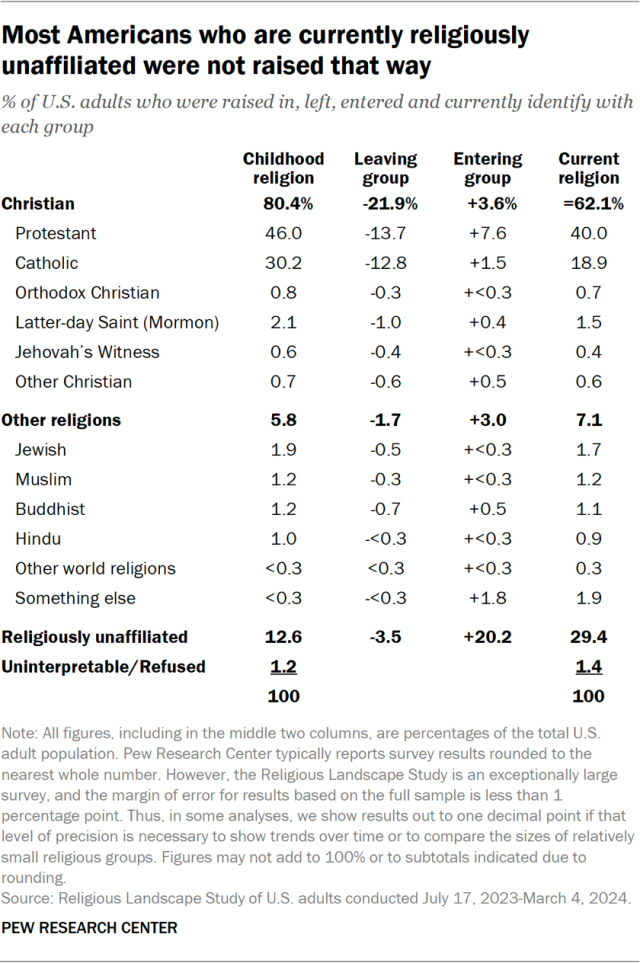
At the same time, religious switching is far from rare. Roughly 35% of U.S. adults no longer identify with the religion of their childhood. This group includes those who have joined a different religion and, more commonly, those who now identify as religiously unaffiliated.
When asked why they left, former adherents most often point to belief itself. Nearly half say they stopped believing in the religion’s teachings. Others say religion simply became unimportant in their lives or that they gradually drifted away rather than making a single decisive break. For many, leaving is not a dramatic rejection but a slow uncoupling from ideas and practices that no longer resonate.
Social and institutional factors also play a role. About a third cite religious teachings on social or political issues, while a similar share mentions scandals involving clergy or religious leaders. These concerns do not dominate the story, but they clearly contribute to erosion of trust, especially when paired with doubts about belief.
“Nones” and the redefinition of spirituality
Nowhere is this shift more visible than among the religiously unaffiliated, often called “nones.” This group, composed of atheists, agnostics, and those who say they are “nothing in particular,” now makes up 29% of U.S. adults.
Contrary to common assumptions, most nones do not describe themselves as hostile to spirituality. Instead, they articulate a reframing of moral and spiritual life. More than three-quarters say they can be moral without religion. Nearly two-thirds question many religious teachings, and a majority say they do not need religion to be spiritual.
Distrust of institutions also looms large. About half say they dislike religious organizations or do not trust religious leaders. A smaller but notable share describes religion as actively harmful, while others say they remain open to belief in God or sacred texts but see no reason to affiliate formally.
This pattern may help explain the overlap between the “none” category and contemporary spiritual currents often described as New Age, eclectic, or individualized spirituality. Rather than rejecting transcendence outright, many Americans are rejecting institutional authority, fixed doctrine, and inherited labels, while still seeking meaning, ethics, and connection on their own terms.
via PEW RESEARCH CENTER
Who switches and when
Perhaps as expected, timing matters, and younger folks changed more. An overwhelming 85% of Americans who have switched religious identities say they did so by age 30, with nearly half making the change before adulthood. This holds true even among older adults, suggesting that religious identity is most malleable early in life.
Those who move from religion to no religion tend to do so earlier than those who switch between religious traditions or who adopt religion after being raised unaffiliated. Leaving often coincides with adolescence or young adulthood, a period notably marked by education, exposure to new ideas, and renegotiation of inherited identities.
Political and social context also shape outcomes. Republicans who were raised in a religion are significantly more likely than Democrats to retain that religion into adulthood, while Democrats are more likely to become unaffiliated. Similarly, people raised in highly religious households are far more likely to remain religious than those raised in homes where religion played a minor role.
Retention, conversion, and the minority paths
Retention rates vary widely by tradition. Hindus, Muslims, and Jews have the highest rates of continuity, while Catholics, Latter-day Saints, and Buddhists see substantially more attrition. Meanwhile, a small but notable group, about 3% of U.S. adults, were raised with no religion and later joined one, a reminder that religious change is not a one-way street.
Older adults raised as religious “nones” are far more likely than younger ones to have adopted a religion later in life, suggesting that spiritual seeking can re-emerge in response to aging, personal crisis, or shifting life priorities.
Notably, neither this study nor its underlying datasets offer specific insight into modern Paganisms. The Pew Research Center uses a broad “other religions” category in its global datasets, which includes Wiccans and likely other Pagan traditions alongside groups such as Unitarian Universalists and Pantheists. In its Religious Landscape Study (the source of the current analysis) Pew notes that this “other religions” category has grown in absolute numbers, roughly keeping pace with global population growth. Worldwide, about 1.9% of respondents identify within this grouping, though the category’s breadth makes it difficult to draw conclusions about any single tradition within it.
What the data does make clear is the broader pattern underlying religious change. People tend to stay when belief, meaning, and positive experience align. They leave when belief fades, institutions disappoint, or religion no longer feels necessary to their moral or spiritual lives. At the same time, growing numbers of Americans are not abandoning spirituality altogether but are instead crafting religious or spiritual identities outside traditional frameworks.
In that sense, the rise of the religiously unaffiliated and spiritually eclectic movements is not a simple rejection of religion. Rather, it reflects an ongoing renegotiation of faith, identity, and meaning, one shaped by pluralism, personal experience, and a widening range of options for how Americans understand the sacred.
The Wild Hunt is not responsible for links to external content.
To join a conversation on this post:
Visit our The Wild Hunt subreddit! Point your favorite browser to https://www.reddit.com/r/The_Wild_Hunt_News/, then click “JOIN”. Make sure to click the bell, too, to be notified of new articles posted to our subreddit.