
TALLAHASSEE, Fla. – Florida has become the first state in the nation to formally adopt the Phoenix Declaration, an education blueprint crafted by the Heritage Foundation and closely associated with the policy ambitions of Project 2025. The move places Florida at the center of a growing national debate over the purpose of public education, the role of religion in civic life, and the ideological direction of state-level educational policy.
The name itself, “Phoenix,” carries a long mythological lineage. The Phoenix, the immortal bird said to rise from its own ashes, appears in Hellenistic stories but draws heavily from much older traditions. Most notably, the Egyptian Bennu bird, associated with the sun god Ra and the renewal of life, shares striking symbolism with the later Greek myth. Herodotus, the 5th-century BCE historian, is often credited with transmitting this imagery into the classical world. The Phoenix, of course, is an unmistakably pagan symbol, deeply rooted in ancient religious imagination.

A Phoenix from Friedrich Justin Bertuch, picture book for children, 1790–1830, mythical creatures. [public domain
Yet despite its name and mythic resonance, the Phoenix Declaration’s origins lie in a conservative ideological effort, rooted in Christian moral theory, to reshape public education from the ground up, using the metaphor of failing institutions rising from the ashes. As the Heritage Foundation writes, “In this time of moral and political crises, when too many schools have lost their way, it is the responsibility of America’s parents, educators, and policymakers to recommit ourselves to the central purposes of education.” The document further asserts that “Every child should have access to a high-quality, content-rich education that fosters the pursuit of the good, the true, and the beautiful, so that they may achieve their full, God-given potential.”
At first glance, this language may sound reminiscent of Enlightenment ideals, an education grounded in knowledge, character formation, civic virtue, and the cultivation of an informed citizenry. However, the philosophical foundation of the modern Phoenix Declaration is explicitly religious. In an accompanying essay, “The Conservative Vision of America,” Dr. Ryan Anderson argues for “framing education in terms of knowledge, and the transcendentals: the true, the good, and the beautiful.” He adds that because Protestants, Catholics, and non-Christians historically disagreed about doctrine, the American public sphere falsely assumed that leaving God out of civic life was “neutral.” As Anderson writes, “But it isn’t. It cultivates and normalizes a kind of practical atheism.”
Anderson is a well-known conservative commentator whose work has focused on opposing abortion access, LGBTQ rights, same-sex marriage, and bans on conversion therapy, positions that have shaped much of his public reputation. His framing of the Phoenix Declaration reflects a broader effort to reintroduce explicitly Christian moral reasoning into public education, a central ambition of the Heritage Foundation’s wider political project.
The Phoenix Declaration itself is not entirely new. A different document bearing the same name appeared in 2000, when Christian clergy in Phoenix issued a public statement affirming LGBTQ+ inclusion within Christianity. That declaration served as a counter-voice to rising anti-LGBTQ rhetoric in religious spaces, emphasizing that LGBTQ+ individuals “are fully loved by God and deserving of dignity,” and rejecting the misuse of scripture to justify harm. While historically notable, that earlier declaration has no relationship to the Heritage Foundation document now being debated in Florida and elsewhere. The two share a name but represent sharply contrasting visions of theology, education, and civic life.
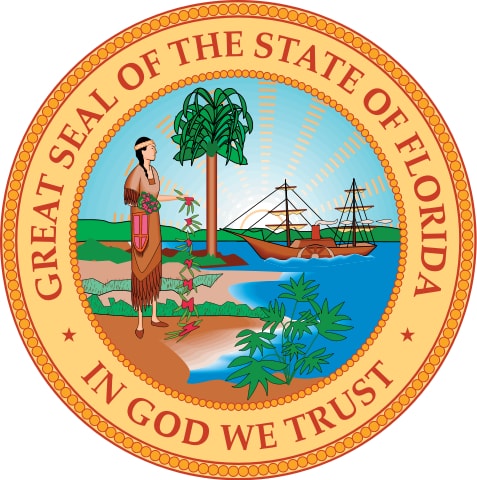
The Great Seal of Florida
Florida’s adoption of the Phoenix Declaration sets forth principles meant to guide schools and policymakers. These include parental choice and responsibility, institutional transparency, truth and virtue, cultural transmission, character formation, academic quality, and civic responsibility. The document opens with the assertion that the nation’s schools have “lost their way” and closes with a list of guiding tenets that call for:
- Parental choice, with education funding following students to the schools parents choose.
- Transparency, requiring schools to disclose instructional content and student information.
- Commitment to objective truth, particularly in science instruction.
- Cultural transmission, emphasizing America’s “roots in the broader Western and Judeo-Christian traditions.”
- Character formation, discipline, and accountability.
- Academic excellence grounded in traditional subjects and classical methods.
- Patriotism and civic gratitude, including renewed respect for the Pledge of Allegiance and national anthem.
The Heritage Foundation authored the Declaration, and although it is not formally listed as a component of Project 2025, the two share architects, ideological commitments, and overlapping policy goals. Project 2025 is a sweeping conservative roadmap designed to restructure federal governance and remake public policy across multiple sectors, including education. Several news outlets have reported that the Declaration “champions” or advances the aims of Project 2025, even if it exists outside the project’s official documents.
Florida Education Commissioner Anastasios “Stasi” Kamoutsas praised the Declaration in strong terms. “I don’t know how anyone could oppose parental choice and responsibility, curriculum transparency, academic excellence, or instruction grounded in objective truth,” he said. “This is a tremendous opportunity for Florida to be the first state in the nation to adopt this declaration and clearly articulate what we believe education should be.”
Critics counter that the Phoenix Declaration is political in its aims, not merely philosophical. The Florida Education Association (FEA), the state’s largest professional association for educators, condemned its adoption as “a political campaign disguised as a declaration” and “a political pledge.” In a statement following the vote, the FEA argued, “Florida’s students and families deserve real investment in their public schools, not a political pledge written by outside organizations.” The organization further called the Declaration “the latest thinly veiled attempt by billionaire-backed special interests to dismantle and politicize Florida’s public education system,” urging the state instead to address chronic teacher shortages and underfunding.
State Board of Education chair Ryan Petty insisted the document reflects universal values. “The purpose of education is the pursuit of truth,” he said. “There are objective truths students must learn. Truth is not ideological—it simply is—and we should not allow ideology to overshadow it.”
Florida is likely not the last state to consider adopting the Declaration. Signatories include several influential officials in Oklahoma, South Carolina, Wyoming, and New Hampshire—jurisdictions where similar adoption efforts may soon appear. Signatories are listed “for identification purposes only,” the document notes, yet their public endorsements suggest a coordinated national strategy.
Parents in Florida also voiced unease. Dahlonega Peck of Gainesville summarized the concerns of many: “The fact that the Heritage Foundation wrote it, that it’s out of Project 2025 – this is indoctrination dressed up in pretty words.”
The Phoenix Declaration was authored by the Heritage Foundation’s Phoenix Declaration Drafting Committee. Below is a full list of its current institutional signatories and the public officials who have supported it:
Drafting Committee
- Chair: Jason Bedrick, The Heritage Foundation
- Daniel Buck, Wisconsin Institute of Law & Liberty
- Lindsey Burke, The Heritage Foundation
- Jonathan Butcher, The Heritage Foundation
- Rachel Cambre, Belmont Abbey College
- Madison Doan, The Heritage Foundation
- Erika Donalds, Optima Education
- Jay P. Greene, The Heritage Foundation
- Gary Houchens, Western Kentucky University
- Matthew Ladner, The Heritage Foundation
- Adam Kissel, Cardinal Institute
- Robert Pondiscio, American Enterprise Institute
- Theodor Rebarber, AAT Education
- James Shuls, Institute for Governance and Civics at Florida State University
- Donald W. Sweeting, Colorado Christian University
Institutional signatories
- The 1776 Project Foundation
- The American Culture Project
- Center for Christian Virtue
- Classical Commons
- The Coalition for Jewish Values
- The Education Freedom Institute
- The Heritage Foundation
- The National Association of Scholars
- Parents Defending Education
- United States Christian Education Network
- Young America’s Foundation
Public Officials
- Governor Kevin Stitt, Oklahoma
- The Honorable Scott Walker, former governor, Wisconsin
- Megan Degenfelder, Superintendent of Public Instruction, Wyoming
- Manny Diaz, former Commissioner of Education, Florida, now interim president of the University of West Florida
- Frank Edelblut, Commissioner of Education, New Hampshire
- Ryan Walters, Superintendent of Public Instruction, Oklahoma
- Ellen Weaver, Superintendent of Education, South Carolina
- Ryan Petty, Vice Chair, Florida State Board of Education

The Wild Hunt is not responsible for links to external content.
To join a conversation on this post:
Visit our The Wild Hunt subreddit! Point your favorite browser to https://www.reddit.com/r/The_Wild_Hunt_News/, then click “JOIN”. Make sure to click the bell, too, to be notified of new articles posted to our subreddit.