

Uncovering the Past
IBIZA, Spain – Hercules, known to the Greeks as Herakles, was the divine hero born of Zeus and the mortal Alcmene. Renowned for his immense strength and courage, he was condemned to perform twelve labors as penance for killing his family in a fit of madness caused by Hera. His adventures, slaying the Nemean Lion, capturing Cerberus, and stealing the apples of the Hesperides, became central to Greco-Roman mythology. Venerated across the Mediterranean, Hercules was honored as both protector and civilizing force, blending divine might with human endurance. Temples dedicated to him appeared from Greece and Sicily to Iberia and North Africa, where he symbolized heroism and perseverance.
Across the Mediterranean, especially in Italy, Spain, and Greece, Hercules remains an enduring emblem of resilience and protection. Statues and place names, such as Cádiz’s Pillars of Hercules or Rome’s Ara Maxima Herculis, are reminders of ancient cult sites where he was once worshiped. Cities like Seville still feature Hercules in civic heraldry as a legendary founder.
While few worship him in the same manner as in classical antiquity, Hercules continues to be venerated today among contemporary Hellenic polytheists and reconstructionist Pagans, as well as others. In some traditions, Hercules represents the archetype of spiritual struggle, the initiate’s triumph over inner monsters. His labors are read allegorically as steps toward enlightenment or moral purification.
This week, a remarkable wooden sculpture of the hero Hercules was announced as having emerged from the wet soil of Ibiza, astonishing archaeologists with its state of preservation. The discovery was unearthed during a routine preventative excavation ahead of a new social housing project. The statue has been hailed as one of the most extraordinary organic finds ever made in the Balearic Islands.
The foot-tall (30-centimeter) statue, which depicts the muscular hero armed with a club or lion skin, was delicately wrought in the Greco-Roman style. It was recovered from an ancient Roman grain silo that was later apparently repurposed as a refuse pit. The site sits beneath land slated for 60 new housing units. The statue may appear unassuming, but archaeologists say its significance goes far beyond its appearance.
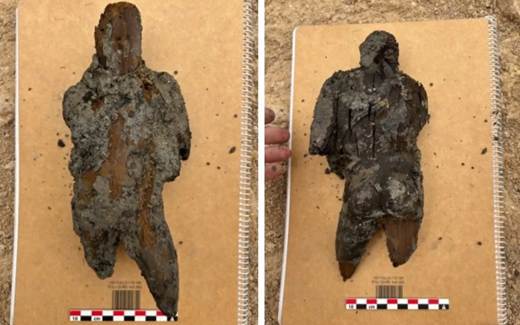
Hercules statue just after excavation at Ibiza. [ Courtesy Archaeological Museum of Ibiza and Formentera- MAEF
“Wood never preserves well in Ibiza,” explains archaeologist Juan José Marí Casanova, co-director of the excavation. “It’s not like Egypt, where the dryness protects everything. Here, wood and organic materials always rot. But in this case, the water protected it—it didn’t destroy it.”
Excavation began in July, under the direction of archaeologists Glenda Graziani Echávarri and Marí Casanova, leading a team of three specialists and sixteen workers. Excavations of this kind are not uncommon before building.
The area, near the Vila courthouse square, lies barely 3 feet (1.2 meters) above the water table. To reach the deeper layers, crews had to install a diaphragm wall and eight pumps, ultimately working about 23 feet (7 meters) underground to reveal successive Roman, Byzantine, and Andalusian strata.
At that depth, archaeologists found the wooden Hercules sealed within what they labeled UE 205, a well-like structure that had filled with water and silt over centuries. But the pit’s low oxygen environment prevented bacterial decay and, ultimately, preserved not only the sculpture but also fragments of leather, seeds, and plant material.
“The well acted like a capsule sealed by water and mud,” says Casanova. “It created a chemical balance where microorganisms couldn’t survive. That’s why the wood remained intact for nearly two thousand years.”
In antiquity, Ibiza was known as Ebusus, a Carthaginian outpost that became part of the Roman world after Carthage’s fall in 146 BCE. Under Roman administration, Ebusus flourished as a prosperous port city, serving as a key commercial hub in the western Mediterranean. Archaeological layers from this era have been found throughout Ibiza Town, but organic artifacts such as wood are virtually unheard of.
The extraordinary preservation of the Hercules statue has opened new possibilities for understanding daily life, craftsmanship, and trade during Ibiza’s Roman period. “In Ibiza, organic material simply doesn’t survive,” Casanova explains. “The heat, humidity, and salinity of the soil destroy everything. Finding this piece changes what we thought possible.”
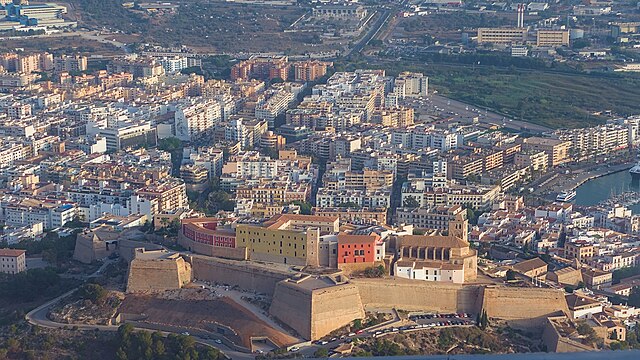
Eivissa with Dalt Vila and Ibiza Cathedral from an airplane [Photo Credit UnFUG-Fabi CCA-SA 4.0
The Roman Well of Hercules
The sculpture undergoes special conservation at the Archaeological Museum of Ibiza and Formentera (MAEF). There, specialists are cleaning and stabilizing the wood using precision humidification to prevent cracking. “After centuries underwater, if the wood dries too quickly, it crumbles,” warns Marí. The process, expected to take months, will ensure the sculpture’s long-term survival and eventual public display.
Other objects from the same level include leather fragments, wooden pieces, and seeds—evidence that this refuse pit was used for domestic waste disposal during late antiquity. Archaeologists hope these finds will shed light on food storage, trade, and local materials used by Ibiza’s Roman inhabitants.
Excavations also revealed traces of a medieval Andalusian settlement built over the Roman foundations, including hearths, storage areas, and household remains. The combination of these layers offers a rare window into the island’s urban and agricultural evolution from antiquity through the Middle Ages.
The recovered plant material and charcoal samples are being studied as part of the MEEDGREENREV Project (Rethinking the Green Revolution in the Medieval Western Mediterranean), funded by the European Research Council and coordinated by the universities of Barcelona, Granada, Reading, and York. By analyzing seed and fruit remains, researchers hope to reconstruct Ibiza’s historical ecology and identify the crops cultivated in its ancient soils.
“It may sound less spectacular than the Hercules itself,” says Marí, “but these seeds will help us understand how people farmed and adapted to this island environment centuries ago.” Indeed, the find is both a triumph of natural preservation, with water serving as a guardian rather than a destroyer.
The Wild Hunt is not responsible for links to external content.
To join a conversation on this post:
Visit our The Wild Hunt subreddit! Point your favorite browser to https://www.reddit.com/r/The_Wild_Hunt_News/, then click “JOIN”. Make sure to click the bell, too, to be notified of new articles posted to our subreddit.