
NEMI, Italy — It began, fittingly enough, near the Temple of Diana Nemorensis. On a secluded, wooded path above the shores of Lake Nemi, I happened upon a traveler asking for directions to the sanctuary. I pointed the way. “I thought you might know,” he said, thanking me and adding that he had once tried to find another Temple of Diana—supposedly located near a Temple of Venus in the Baths of Baia outside Naples. The traveler disappeared into the woods, but his passing remark set off an unexpected hunt (no puns intended), perfectly suited to The Wild Hunt, and ultimately led to an extraordinary archaeological revelation tied to Naples’ 2,500th anniversary.
The city of Naples began marking that milestone on March 25, 2025, commemorating its foundation as Neapolis (“New City”) around 470 B.C. Festivities span the entire year and will conclude near the winter solstice, traditionally observed as the city’s symbolic birthday. While Neapolis traces its classical origins to Greek settlers, even older layers of habitation, dating to the 9th-century B.C. colony of Parthenope, lie beneath its streets.
The initial comment by the lakeside visitor pointed not to the city itself but to the nearby Archaeological Park of the Baths of Baia (Parco Archeologico delle Terme di Baia) in Bacoli, on the western edge of the Gulf of Naples. The sprawling Roman site, dramatically built into the slopes of an extinct volcano, is famed for its terraced architecture and geothermal ingenuity. Roman engineers here used the area’s natural hot springs to heat pools and rooms in a vast imperial spa complex once favored by emperors.
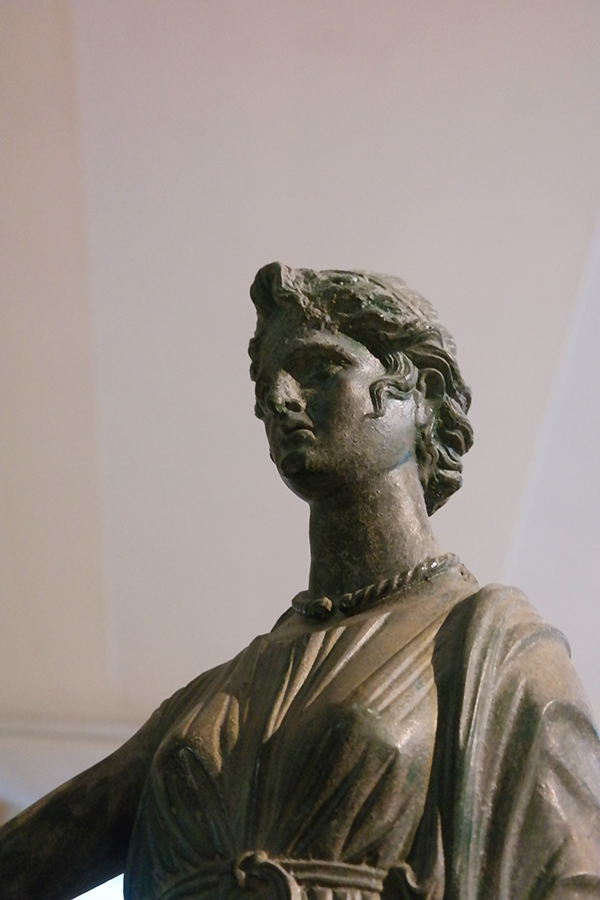
Statue of Diana at Nemi Ships Museum. [Photo Credit: S. Ciotti
Early archaeologists, misled by the grandeur of its domed halls, labeled some of these thermal structures as “temples.” The “Temple of Mercury,” for instance, was long thought to be a shrine before it was recognized as an enormous swimming hall, or natatio, celebrated for its pioneering concrete dome and remarkable acoustics. Similarly, the so-called “Temples” of Diana and Venus were not sanctuaries at all, but parts of the same bath system, opulent halls decorated with marble reliefs and mythological imagery.

We know it’s a pain to ask for money—but here are the facts.
Since January, The Wild Hunt’s readership has soared past 400,000 views a month. That’s humbling—but higher reach also means higher costs. Hosting, technology, and reporting all add up.
Our editors are unpaid, and some of our staff volunteer their time. But we believe everyone deserves to be paid for their work.
We tried advertising once, and readers were flooded with Christian ads. That’s not who we are. The Wild Hunt is dedicated to providing Pagan readers perspectives they won’t see anywhere else.
We’ll never hide our stories behind a paywall—our community deserves access, no matter their ability to pay. To keep Pagan news free, independent, and authentic, we rely on you.
A few hundred supporters pledging $10 a month—or more if you can—would keep The Wild Hunt secure for the year. If you’ve been thinking about supporting us, now is the time.
👉 This is how you can help:
Tax-Deductible Donation
PayPal
Patreon
As always, our deepest gratitude to everyone who has brought us this far.
The error, although persistent in tourist lore, reflected 18th- and 19th-century romantic notions more than archaeological fact.
Yet while Diana never had a true temple at Baia, the goddess of the hunt turns out to have had one in Naples itself, and the (re) discovery of the provenance of her temple has only just come to light.
Archaeologists, historians, and clergy have long known that the Basilica di Santa Maria Maggiore alla Pietrasanta, in the heart of Naples’ historic center, stands directly atop an ancient Roman temple dedicated to Diana.
According to tradition, Bishop Pomponio built the basilica in the 6th century A.D. on the ruins of that pagan temple, marking one of the earliest Christian sanctuaries in the city dedicated to the Virgin Mary.
Archaeological work carried out during restorations strengthened that legend. Beneath the basilica’s floors, researchers found fragments of Roman masonry and—most intriguingly—an inscribed marble plaque referencing a fratria, or brotherhood, of the Artemisii, families devoted to the worship of Artemis (the Greek counterpart of Diana). The inscription, recorded in antiquarian accounts but missing for centuries, had been presumed lost since the early 1600s.
Its disappearance was one of Naples’ enduring historical mysteries—until now.
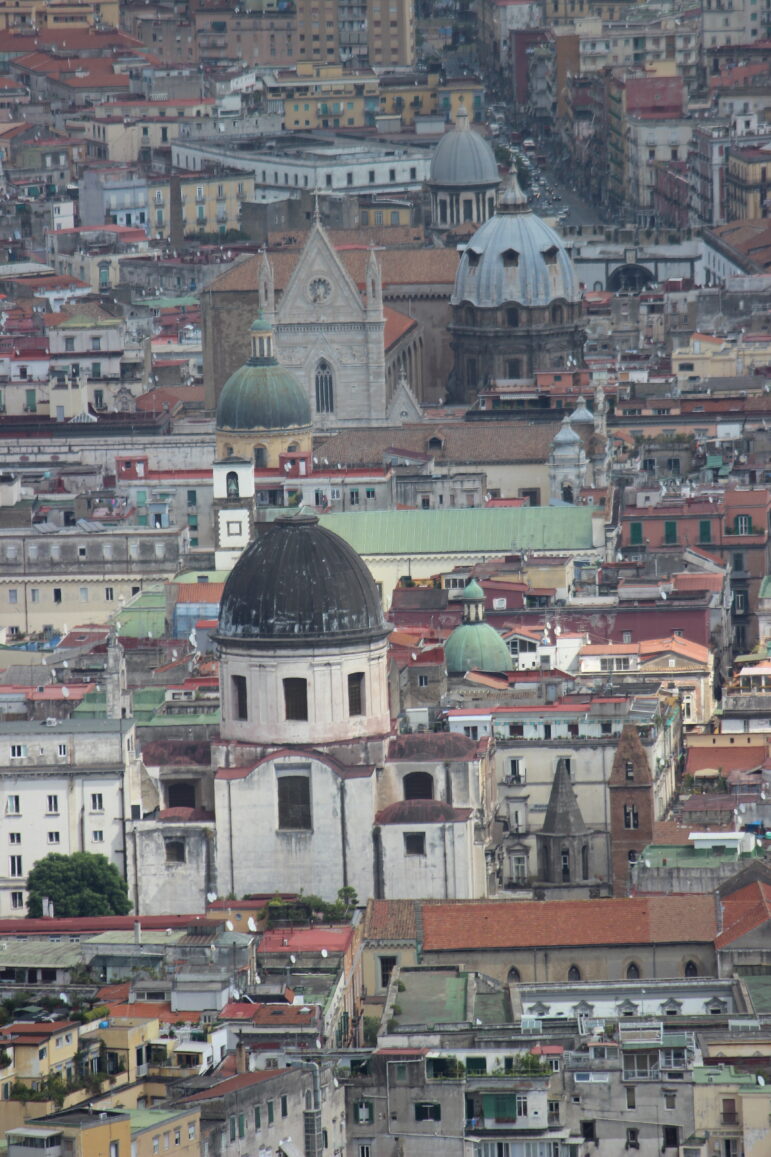
A view of Chiesa di Santa Maria Maggiore alla Pietrasanta [{hoto Credit: Miguel Hermoso Cuesta CCA-SA 4.0
Earlier this year, during a recent restoration at the Church of Santa Maria delle Grazie ad Alberi, a small parish in the hillside hamlet of Meta on the Amalfi Coast, workers removing a wall tablet found another slab hidden behind it. When the outer stone was lifted, the inner surface revealed Latin text identifying the same fraternity of the Artemisii (The Society of Diana) once documented at Naples’ Pietrasanta basilica.
The long-lost marble had resurfaced 400 years after vanishing from the city.
Scholars Enzo Puglia and Pasquale Vanacore, who traced the object’s odyssey in La Terra delle Sirene journal, confirmed the match. According to their reconstruction, a priest visiting Naples in 1607 had taken the marble to Meta to reuse it for a family memorial—then a common practice. The slab was flipped and engraved anew, inadvertently preserving the older inscription on its reverse side.
“It wasn’t a theft,” Puglia explained in an earlier interview. “In that period, ancient marbles were considered reusable materials. The priest acted in good faith, not realizing he was carrying off a key piece of Naples’ religious history.”
The rediscovery has sparked excitement among archaeologists and civic leaders alike. Lello Iovine, president of the Pietrasanta Foundation, called it “a birthday gift to the city.”
“We, like all Neapolitans and scholars, have always been certain that the remains beneath the basilica were attributable to the Temple of Diana,” Iovine said. “Now the document confirming that attribution has come to light. It would be thrilling to see that plaque return, even temporarily, to its ancient location in front of the basilica.”
Iovine has proposed that the marble, now displayed in Alberi so both faces can be read, be loaned to Naples during the city’s anniversary celebrations. The Pietrasanta Foundation has offered to handle transportation, security, and exhibition logistics if the Superintendency approves the transfer.
Local reaction has been warm but cautious. The parish priest in Alberi, while supportive, is understandably surprised by his church’s unexpected treasure. The relic draws curious visitors to the tiny community perched above the Amalfi coast, a welcome boost for local tourism.
Iovine emphasized that his plan is one of collaboration, not competition.
“I don’t think of demanding its restitution,” he said. “That marble has belonged to the parish for hundreds of years, and it’s right that it stays there. But I hope we can cooperate so the inscription can be shown in Naples for a few months—a gesture of unity between two sacred places and two moments in our shared history.”
If realized, the temporary return would form a symbolic closing of a historical circle: the goddess of the hunt, once worshipped in Naples, acknowledged again within the basilica that replaced her temple nearly fifteen centuries ago.
For archaeologists, the rediscovery provides tangible proof of that transition, from the adoration of Diana to the adoration of Mary, reminding everyone how Pagan sanctuaries were not erased, but absorbed and overwritten. For the city itself, the marble stands as a witness to 2,500 years of devotion layered upon the same sacred ground.
The Wild Hunt is not responsible for links to external content.
To join a conversation on this post:
Visit our The Wild Hunt subreddit! Point your favorite browser to https://www.reddit.com/r/The_Wild_Hunt_News/, then click “JOIN”. Make sure to click the bell, too, to be notified of new articles posted to our subreddit.