
PHOENIX – The Wild Hunt has followed the legal battle at Oak Flat for years. The legal battle continues to expose boundaries of the United States’ approach to religious freedom, Indigenous sovereignty, and environmental stewardship, all of which converge in this struggle from the Arizona desert.
At the heart of the dispute lies Chi’chil Biłdagoteel, known in English as Oak Flat, and near the town of Superior, is an approximately 2,400-acre high desert plateau within the Tonto National Forest, about 60 miles east of Phoenix.
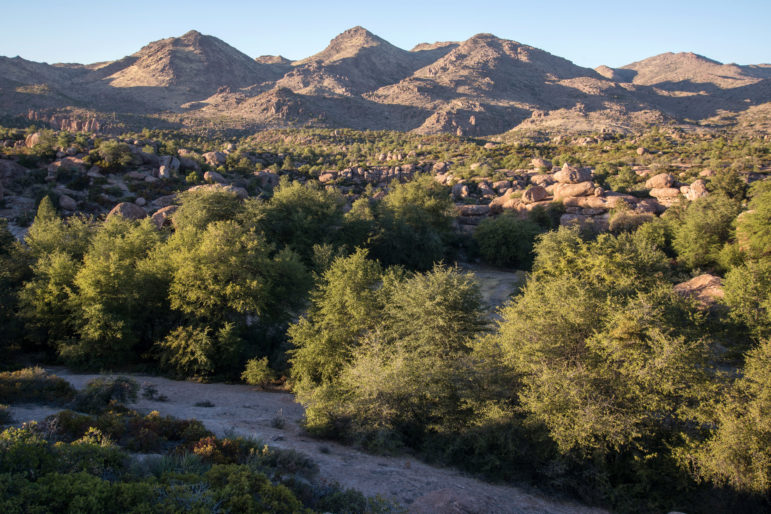
Emory oak grove at Oak Flat, AZ – Image credit: Copyright © 2020 Elias Butler Photography All Rights Reserved – CC-BY-SA-4.0
To the Western Apache, and to neighboring Diné (Navajo) and other Indigenous peoples of the region, this is no ordinary landscape. The Apache believe Oak Flat was touched by the Creator and is a place where the Ga’an, sacred mountain spirit beings, dwell. It is a corridor between worlds where they commune with the sacred, collect medicinal plants, and honor their ancestors. As Apache elder and former tribal chairman Wendsler Nosie Sr. has said, “Oak Flat is life-giving.” The mountaintop gathers snow that becomes water, sustaining plants, animals, and humans alike.
The site, however, also sits atop one of the largest untapped copper deposits in North America. A decade-old deal between the U.S. Forest Service and Resolution Copper, a mining company jointly owned by Anglo-Australian giants Rio Tinto and BHP, would transfer Oak Flat into private hands in exchange for other lands elsewhere in Arizona. The mine’s proponents say it could generate billions of dollars and thousands of jobs in the state’s Copper Triangle. To reach the ore, the company would use block-cave mining, a technique that collapses the ground from beneath, eventually leaving behind a crater nearly two miles wide and 1,000 feet deep, essentially erasing Oak Flat from the face of the Earth.

We know it’s a pain to ask for money—but here are the facts.
Since January, The Wild Hunt’s readership has soared past 400,000 views a month. That’s humbling—but higher reach also means higher costs. Hosting, technology, and reporting all add up.
Our editors are unpaid, and some of our staff volunteer their time. But we believe everyone deserves to be paid for their work.
We tried advertising once, and readers were flooded with Christian ads. That’s not who we are. The Wild Hunt is dedicated to providing Pagan readers perspectives they won’t see anywhere else.
We’ll never hide our stories behind a paywall—our community deserves access, no matter their ability to pay. To keep Pagan news free, independent, and authentic, we rely on you.
A few hundred supporters pledging $10 a month — or more if you can — would keep The Wild Hunt secure for the year. If you’ve been thinking about supporting us, now is the time.
👉 This is how you can help:
Tax-Deductible Donation
PayPal
Patreon
As always, our deepest gratitude to everyone who has brought us this far.
On October 6, the U.S. Supreme Court, for the second time this year, declined to hear the appeal of Apache Stronghold v. United States, leaving unresolved one of the most consequential cases for Indigenous and interfaith religious liberty in a generation.
Since 2014, when Arizona lawmakers led by the late Sen. John McCain attached the Oak Flat land exchange to a “must-pass” defense spending bill, Indigenous nations, environmentalists, and religious groups have fought to stop it. Apache Stronghold, a grassroots coalition founded by Nosie and supported by the Becket Fund for Religious Liberty, argues that the transfer would violate the First Amendment and the Religious Freedom Restoration Act (RFRA), by effectively destroying a sacred site indispensable for worship. As one advocate summarized, “Religious freedom is universal. It doesn’t apply only if you believe certain things or belong to a certain tradition.”
In March 2024, the Ninth Circuit Court of Appeals, sitting en banc, ruled 6–5 against Apache Stronghold, rejecting the group’s claim that transferring Oak Flat violated the Religious Freedom Restoration Act. The coalition then appealed to the U.S. Supreme Court.
On May 27, 2025, the Court declined to hear the case. Justice Neil Gorsuch, joined by Justice Clarence Thomas, dissented sharply, arguing that the lower court’s decision “denied the Apache the same protections other faiths enjoy.” Justice Samuel Alito recused himself from the matter.
In June 2025, Apache Stronghold filed a petition for rehearing, citing a newly issued environmental impact statement and ongoing lower-court proceedings. The Supreme Court again denied review on October 6, 2025, with Gorsuch noting simply that he “would have granted the petition.”
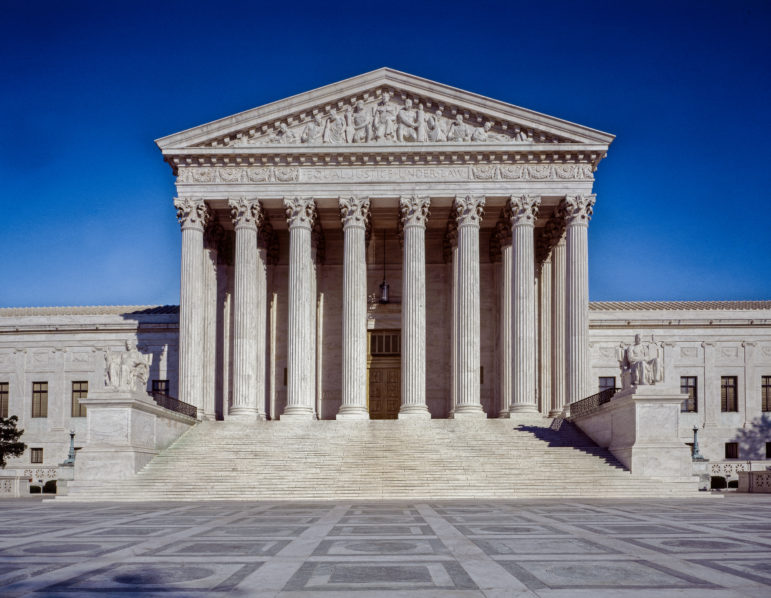
United States Supreme Court Building By Carol M. Highsmith – Library of CongressCatalog: http://lccn.loc.gov/2011631106Image download: https://cdn.loc.gov/master/pnp/highsm/12900/12912a.tifOriginal url: http://hdl.loc.gov/loc.pnp/highsm.12912, Public Domain, https://commons.wikimedia.org/w/index.php?curid=91285025
In response, Apache Stronghold issued a statement:
“Oak Flat deserves the same respect and protection this country has long given to other places of worship.”
The group’s lawyers vowed to continue in the lower courts. Three related cases, including one led by a group of Apache women invoking parental religious rights affirmed in a recent Supreme Court ruling, are now pending before the Ninth Circuit, with arguments set for January 7, 2026.
Politics and Pressure
In August, Reuters reported that former President Donald Trump met privately with Rio Tinto and BHP executives, along with Interior Secretary Doug Burgum, signaling support for the mine. The next day, Trump derided mine opponents — many of them Indigenous — as “anti-American.” Company officials expressed confidence that the courts would ultimately uphold the land transfer.
For the Apache and their allies, the issue transcends politics. “What is evil created the unfairness, not just to us human beings but to all of God’s creations,” Nosie said after the Supreme Court’s October decision. “We must defend what is spiritual, holy, and God’s greatest gift to us all — our Mother Earth.”
An Interfaith Movement
That call has not gone unanswered. Across faith traditions, religious leaders are linking the Apache struggle to the broader defense of sacred space and spiritual freedom.
In July, nine Catholic sisters from across the country joined Apache elders and youth for three days of prayer, dance, and shared meals at Oak Flat. The women, members of the Dominican Sisters of Peace and other congregations, carried signs reading “Nuns Support Apache Religious Freedoms” and “Complicit No More.” Surrounded by ancient Emory oaks, they joined Apache Crown Dancers in ritual movement and storytelling.
Sister Susan Leslie, a Dominican Sister of Peace, recalled, “I went expecting to be a person of prayerful support, but I did not anticipate being invited into their ceremonies. We weren’t bystanders — we were actively engaged. It was an experience of people incredibly rooted in their faith.”
The interfaith momentum has continued to grow.
On Indigenous Peoples’ Day, October 13, faith leaders gathered at a prayer vigil to express solidarity. The event, livestreamed nationally, included Apache, Diné, Episcopal, Jewish, Presbyterian, and Unitarian Universalist participants. Rev. Dr. Robin Tanner, president of the Unitarian Universalist Ministers Association, told attendees:
“This is a struggle of protecting Mother Earth, of stopping ecological devastation. It is also a fight for religious freedom — for the U.S. government is trying to say that the Apache do not get to declare what is sacred to them.”
Rev. Michael Black, founder of EarthKeepers 360, added: “We’re working to protect Oak Flat because we recognize that it is vital for the spiritual freedom of the San Carlos Apache, their ancestors, and their descendants.”
A Broader Religious Liberty Question
The Oak Flat cases strike at the heart of a contradiction in U.S. religious freedom jurisprudence. In recent years, the Supreme Court has robustly expanded protections for individual and institutional religious expression — for example, allowing a high school football coach to pray on the field, or affirming parental rights to religious schooling. Yet when Native sacred lands on federal property are at stake, those same protections often vanish.
Legal scholars note that the 1993 RFRA was originally championed by an unusual coalition of Christians, Jews, Muslims, and Native groups, meant to safeguard religious exercise for all. But federal agencies and courts have repeatedly ruled that “burdens” on Indigenous religious practice caused by land use decisions are incidental — not coercive — because the government owns the land. The result, critics say, is a double standard that privileges church buildings but not sacred landscapes.
Despite setbacks, Apache Stronghold and its allies are undeterred. “We call on all people to pray, to raise their voices, and to join us in defending Mother Earth,” Nosie said. “Our judicial system’s voice is muted by capitalism. But the Creator’s voice cannot be silenced.”
Upcoming hearings at the Ninth Circuit in early 2026 will determine whether Oak Flat can be legally transferred before a full review of its environmental and spiritual implications. Meanwhile, the site remains under federal ownership — and under constant vigil by those who see it as a living altar.
For many of the interfaith allies who have joined the movement, the fight for Oak Flat has become emblematic of something larger: whether the United States truly honors its constitutional promise of religious liberty for all faiths, not only for those whose temples are made of stone and glass.
Legal experts have consistently noted that the refusal to uphold the most basic right of religious freedom exposes that true equality among faiths, under U.S. law, remains dubious.
The Wild Hunt is not responsible for links to external content.
To join a conversation on this post:
Visit our The Wild Hunt subreddit! Point your favorite browser to https://www.reddit.com/r/The_Wild_Hunt_News/, then click “JOIN”. Make sure to click the bell, too, to be notified of new articles posted to our subreddit.