
SALT LAKE CITY – In 2024, the Utah Legislature passed SB150: Exercise of Religion Amendments. The passage of the bill made Utah the 36th state in the nation to adopt its own version of the federal Religious Freedom Restoration Act (RFRA).
Modeled after the federal law passed in 1993, Utah’s SB150 prohibits government entities from substantially burdening a person’s free exercise of religion unless the action both furthers a compelling governmental interest and is the least restrictive means of doing so. The 1993 Religious Freedom Restoration Act (RFRA) is a U.S. federal law requiring the government to avoid substantially burdening a person’s free exercise of religion unless it demonstrates a compelling interest pursued through the least restrictive means. It restored strict scrutiny for laws affecting religious practices.
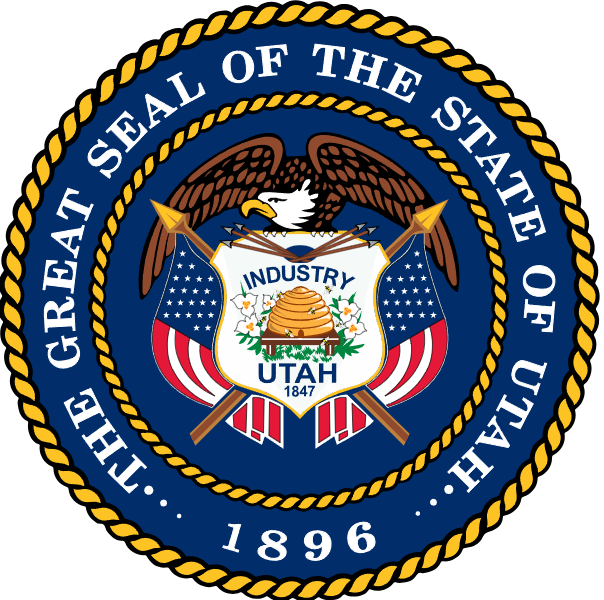
Great Seal of the State of Utah. [public domain]
The original text of the bill raised multiple concerns from various communities and ultimately addressed some of the criticism. LGBTQ+ advocates, for example, lobbied lawmakers to add explicit safeguards to ensure it would not override Utah’s existing civil rights and anti-discrimination protections, including the state’s ban on conversion therapy.
“This bill as drafted, will be the strongest RFRA law that exists in the nation,” said Rep. Jordan Teuscher, R-South Jordan, when the House approved it unanimously. Sen. Todd Weiler, R-Woods Cross, emphasized on the Senate floor, “This is not a bill for any one church or any one religion, it is to codify in our code if the government is impeding on someone’s sincerely-held religious beliefs that they’re going to have to show and meet the highest constitutional standard to do so.”
Governor Spencer Cox signed SB150 on March 21, 2024, and it took effect May 1, 2024. The legislation’s intent is clear: to give Utahns a state-level safeguard for religious liberty even if the federal RFRA were ever repealed.
But within months of becoming law, the state found itself at the center of an unusual legal battle, one involving psychedelic mushrooms.
Last week, U.S. District Judge Jill Parrish issued a striking ruling in a case brought by the Singularism Spiritual Center, a small Provo-based faith group that incorporates psilocybin, the psychoactive compound in certain mushrooms, into its religious practice.
Psilocybin is a naturally occurring psychoactive compound found in certain species of mushrooms, often called “magic mushrooms.” When ingested, the body converts psilocybin into a psychoactive metabolite that produces altered states of perception, mood, and thought. These effects can include vivid visual imagery, spiritual or mystical experiences, and changes in the sense of self.

Fruit bodies of the hallucinogenic mushroom Psilocybe semilanceata [Photo Credit: Arp – CCA-SA 3.0]
In Native American religious practice, psilocybin itself is generally not the central traditional entheogen. Historically, many Native American nations, especially in the Southwest and Great Plains, have used peyote (containing mescaline) in sacred ceremonies, most notably through the Native American Church.
Other Indigenous groups, such as some in Mesoamerica (e.g., the Mazatec, Mixtec, and Nahua peoples of Mexico), have used psilocybin-containing mushrooms ceremonially for centuries, often to communicate with the spirit world, seek healing, and receive guidance.
In these traditions, psilocybin is consumed under the guidance of an experienced spiritual leader or healer, typically in a ritual setting that includes prayers, songs, and symbolic acts. The aim is not recreation but spiritual insight, healing, or connecting with divine beings or ancestors.
The center’s founder, Bridger Jensen, opened the space in 2023, promoting it as “Healing. Safe. Legal” and offering participants, called “voyagers,” psilocybin tea in a supervised, private environment. Jensen maintains that the tea is a sacrament central to the group’s spiritual work, which he describes as an “entheogenic minority religion.”
Jensen grew up in Provo, Utah, within a devout LDS (Latter-day Saints) family. He later explored spirituality across multiple spiritual traditions and had formative psychedelic experiences abroad, including with ayahuasca in Peru and Hawaii. There is no apparent confirmation or evidence that Jensen is Native American.
He did, however, found Singularism, a spiritual belief system that embraces the ceremonial use of entheogenic substances like psilocybin to facilitate deep, profound spiritual experiences, personal insight, and healing.
In November 2024, Provo police executed a search warrant at the center, seizing psilocybin, related records, which Jensen called “sacred scripture,” and other materials. No arrests were made at the time, but Jensen was later charged with possession of psilocybin with intent to distribute, along with misdemeanor drug charges.
Jensen’s lawsuit, filed shortly after the raid, alleges violations of the First and Fourth Amendments, the Utah Constitution, and Utah’s new RFRA.
The complaint argues that prohibiting Singularism from using psilocybin “is not essential to furthering any compelling government interest” and that both U.S. and Utah courts have recognized situations in which the religious use of entheogenic substances is a protected exercise. The suit seeks to have the seized items returned, the criminal case dropped, and damages awarded for losses.
Utah County responded with a motion to dismiss, insisting that the First Amendment does not override the Utah Controlled Substances Act and noting that the state RFRA is so new no court has yet interpreted it. The motion argued the law presents “unsettled, never-before-addressed questions of state law.”
Judge Parrish was unpersuaded. In a sharply worded opinion, she described some of the county’s arguments as “ludicrous” and bordering on “disingenuous.” She granted a preliminary injunction halting all criminal proceedings against Jensen and his faith community until the civil case is resolved.
“The prosecution has already caused Singularism to lose many of its practitioners and affiliates,” Parrish wrote. “Forcing Plaintiffs to wait until the conclusion of the criminal proceedings to secure their free-exercise rights would be the equivalent of issuing a death warrant for their nascent religion.”
Her ruling effectively means that one of SB150’s first courtroom tests will proceed before the law is even a year old. It also places Utah in the national spotlight as courts grapple with how far religious freedom protections can extend, especially when a practice conflicts with state drug laws.
Religions using banned substances are not new to Utah. Former Republican lawmaker Steve Urquhart founded The Divine Assembly in 2020, which also centers on psilocybin use. Native American churches in the state, such as the Oklevueha Native American Church, incorporate peyote or other entheogens into worship. Singularism’s case may determine whether Utah’s new RFRA can accommodate similar practices.
For now, Jensen’s lawsuit will move forward, raising complex questions about where the lines between religious liberty, public safety, and controlled substances law should be drawn. As Parrish noted in her opinion, the stakes are high: without court protection, the group’s ability to survive as a faith community could be extinguished before it has a chance to fully assert its legal rights.
Whether SB150 will shield Singularism’s psilocybin rites remains to be seen. What is clear is that Utah’s newest religious freedom law is being delightfully tested in ways lawmakers may not have anticipated.
The Wild Hunt is not responsible for links to external content.
To join a conversation on this post:
Visit our The Wild Hunt subreddit! Point your favorite browser to https://www.reddit.com/r/The_Wild_Hunt_News/, then click “JOIN”. Make sure to click the bell, too, to be notified of new articles posted to our subreddit.