
Over the past 24 hours, The Wild Hunt has received multiple requests from the community to investigate an issue related to a petition to overturn Obergefell. Given the community concern, we had a look and this is what we know.
As this case progresses—or most likely stalls—The Wild Hunt will continue to follow developments with an eye toward the religious freedom implications for minority and Pagan traditions, not just dominant faith groups.
WASHINGTON, D.C. — Nearly a decade after her refusal to issue same-sex marriage licenses made national headlines, former Kentucky clerk Kim Davis is asking the U.S. Supreme Court to overturn Obergefell v. Hodges, the landmark 2015 ruling that legalized same-sex marriage nationwide.
In a 90-page petition filed July 24, Davis, represented by the conservative legal nonprofit Liberty Counsel, challenges a Sixth Circuit Court decision affirming a $100,000 jury award against her for denying a marriage license to David Ermold and David Moore, a same-sex couple in Rowan County. The appellate court also upheld an order requiring Davis to pay over $260,000 in attorney’s fees.
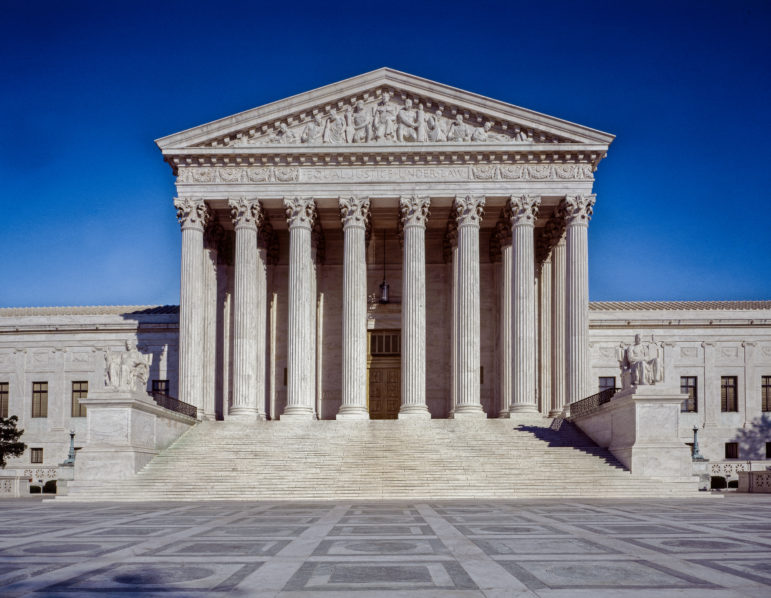
United States Supreme Court Building By Carol M. Highsmith – Library of CongressCatalog: http://lccn.loc.gov/2011631106Image download: https://cdn.loc.gov/master/pnp/highsm/12900/12912a.tifOriginal url: http://hdl.loc.gov/loc.pnp/highsm.12912, Public Domain, https://commons.wikimedia.org/w/index.php?curid=91285025
Davis argues that her First Amendment rights, specifically, the Free Exercise Clause, shield her from personal liability for emotional distress claims brought by the couple. She asserts that issuing the license would have violated her evangelical Christian beliefs and “God’s definition of marriage.” In refusing to comply with the post-Obergefell directive, Davis briefly served five days in jail in 2015.
The petition poses three major constitutional questions for review:
- Whether the Free Exercise Clause provides a defense against tort liability based solely on emotional distress when there are no actual damages.
- Whether a government official, sued in their individual capacity and stripped of immunity, may assert constitutional defenses.
- Whether Obergefell itself should be overruled as wrongly decided, in line with the Court’s reversal of Roe v. Wade in Dobbs v. Jackson Women’s Health Organization (2022).
“If ever a case deserved review,” the petition states, “the first individual who was thrown in jail post-Obergefell for seeking accommodation for her religious beliefs should be it.”.
The Sixth Circuit was unsympathetic. In March 2025, it ruled that Davis, while sued as an individual, was acting in her official government capacity when she denied the license. “[A] §1983 individual-capacity claim seeks to impose personal liability on a government official for actions taken under color of state law,” the court stated. “Such state actions are not protected by the First Amendment.”
The Supreme Court previously declined to take up Davis’s appeal in 2020. However, Justices Clarence Thomas and Samuel Alito issued a notable statement criticizing Obergefell for its “cavalier treatment of religion.” Thomas wrote, “Davis may have been one of the first victims… but she will not be the last.”
That assertion now echoes louder in 2025. Liberty Counsel argues that the Dobbs ruling has weakened the foundation of Obergefell, which was also grounded in the doctrine of substantive due process. “Obergefell was wrong when it was decided and it is wrong today,” the petition reads. “The Constitution makes no reference to same-sex marriage.”
Legal experts remain skeptical. “Not a single judge on the U.S. Court of Appeals showed any interest in Davis’s rehearing petition,” said Bill Powell, counsel for Ermold and Moore. “We are confident the Supreme Court will likewise agree that Davis’s arguments do not merit further attention.”
Nonetheless, the case is arriving at a time of renewed political and legal hostility toward marriage equality. Since 2022, several Republican lawmakers and conservative activists have called for a rollback of Obergefell. In June, the Southern Baptist Convention approved a resolution urging the Court to reverse the ruling. Meanwhile, states such as Kansas and Missouri have retained or introduced statutory language defining marriage as between one man and one woman, which would take effect if Obergefell is overturned. More than 30 states have similar dormant bans.
Though Congress passed the Respect for Marriage Act in 2022 to require federal recognition of same-sex marriages, legal analysts say it does not prevent individual states from ceasing to issue new licenses should Obergefell fall.
The petition also comes during the 10th anniversary of Obergefell. While the legal struggle continues, the case’s namesake, Jim Obergefell, and the original state defendant, Rick Hodges, have become friends. Their continued public appearances mark a stark contrast to the divisive narrative now reignited by Davis’s petition.
Liberty Counsel chairman Mat Staver remains optimistic. “We think it’s not a matter of if, but when the Supreme Court will overrule Obergefell,” he told Religion News Service. He pointed to the Court’s changed composition since 2015—particularly the addition of Justice Amy Coney Barrett—as reason to hope.

Rainbow flag – Image credit: Ludovic Bertron, New York City, US – https://www.flickr.com/photos/23912576@N05/2942525739, CC BY 2.0, https://commons.wikimedia.org/w/index.php?curid=14831997
The high court requires only four justices to grant review. Whether Davis’s petition will clear that bar remains to be seen.
Still, the case has become a rallying point for some conservative legal circles hoping to extend Dobbs-era momentum into new arenas. Some Evangelical and Catholic voices, along with members of the Republican Party, have become increasingly vocal in their efforts to overturn Obergefell. LGBTQ+ rights advocates and legal scholars argue that the stakes are not just symbolic. According to the Movement Advancement Project, more than 60% of LGBTQ+ Americans live in states where their right to marry would be jeopardized if Obergefell is reversed.
For now, national support for marriage equality remains strong. A Gallup poll in May 2025 reported a 71% overall approval rate, though only 41% of Republicans said they support it, a 10-year low.
Whether the Supreme Court accepts Davis’s petition may signal just how much appetite remains among the justices to revisit a decision many Americans see as settled, leaving a potential review as a seemingly political decision rather than a settled legal matter.
The Wild Hunt is not responsible for links to external content.
To join a conversation on this post:
Visit our The Wild Hunt subreddit! Point your favorite browser to https://www.reddit.com/r/The_Wild_Hunt_News/, then click “JOIN”. Make sure to click the bell, too, to be notified of new articles posted to our subreddit.