

After a long stretch of gloom and doom in this column of mine, I promised myself (and you) a breather, so I handed you a sweet book about a Witch who gets to keep both her magic and her happy ending. This month I’m bringing something different to the altar: a video game, and one made by people from my corner of the world, that is, straight from the land of the Saci, the Curupira, and the Iara.
Tiny Witch comes from Creative Hand, a four-person indie studio from Brazil, and after so many seasons of Witches flying onto our screens from Salem, Hollywood, and the English countryside, I find a certain pleasure in handing the broom to a Witch with a Brazilian passport. (Our Tiny Witch doesn’t say a single word in the whole game, which, given how many of my columns have circled around silence, feels almost like an inside joke.)
Two Calendars, One Night
A quick note on what October 31 looks like from down here. Halloween reached Brazil mostly through English schools, cable TV, and the usual cultural tide, and in 2003 the small town of São Luiz do Paraitinga, in São Paulo state, answered with a holiday of its own on the very same date: the Day of the Saci, in honor of the one-legged trickster of our folklore, the boy in the red cap who rides the whirlwinds and gets the blame whenever something goes wrong around the house. São Paulo made the date official statewide in 2004, and several federal bills have since sought to turn it into a national observance.
Add to all this the many Pagans down here who turn the Wheel by the Southern Hemisphere and greet Beltane while the North honors its dead, and the end of October in Brazil becomes a crowded crossroads: jack-o’-lanterns, a little whirlwind with a pipe, and a Maypole, all on the same night. For me, the night gets even more crowded, since October 31 is also my birthday, and every year I blow out my candles somewhere between the pumpkins, the Saci, and the Maypole. Figuratively speaking, of course, but you get the picture.
A game about a tiny Witch selling pumpkin-headed monsters, made in Brazil for the whole world, sits right at that crossroads.
Don’t Let the Pixels Fool You
Now, a warning before anyone rushes to hit the buy button. The screenshots have everything the cozy-game crowd adores: detailed pixel art, a pint-sized Witch, a talking cat, decorations, pets, and of course, pumpkins. Beware, though: the cute look can be deceiving. Behind it waits a frantic order-management game in the line of Overcooked, the kind that keeps your hands busy and your shoulders up around your ears from the first customer of the day to the last.
A Curse Broken by Work
The premise sets the tone. A talking cat grants Sophie the power to brew and the means to open a shop of her own, and she has a knack for buying shops that come with a curse attached. After ten days of business, the curse lifts. The towns are crawling with dungeon lords in need of minions for their lairs (somebody has to keep the adventurers busy). Something Pagan this way comes: the curse gives way to routine, to unlocking the doors every morning and doing the job right. Anyone with a daily practice knows the unglamorous truth behind it—most magic is maintenance.
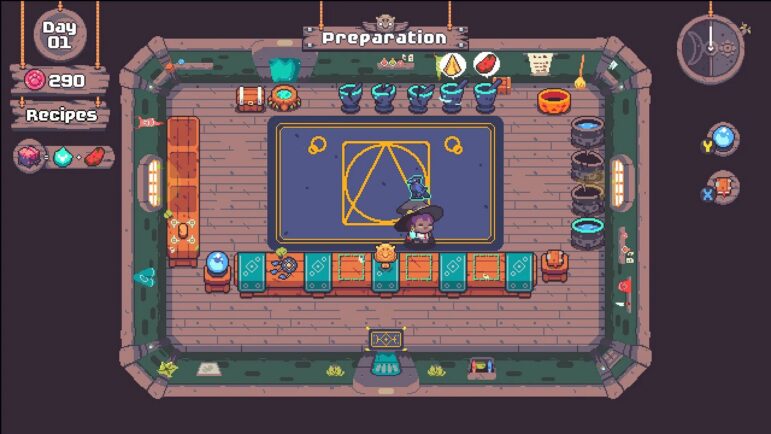
A screenshot from Tiny Witch [Creative Hand]
In the first village, the menu runs on spirits, zombies, skeletons, ghouls, and pumpkin heads—a Halloween costume parade with a price tag. Mushrooms become spirit fragments, ingredients go through the pounder and the cauldron, everything comes together on the alchemy table, and the recipe for each order stays on the screen, so the whole challenge lies in speed and in where each cauldron and pounder sits in the shop.
Retail Witchcraft
Anyone who has ever sold candles and oils at a Pagan fair, or kept a little metaphysical shop afloat, will recognize the clientele. There’s the regular who forgives a delay if you apologize nicely, the customer who starts tapping the counter the moment the door opens, and the well-off one who tips generously and expects miracles in return. In Sophie’s shop, though, patience floats as a visible bar over every head, apologies work on only part of the crowd, and a customer pushed past the limit attacks, which costs her precious seconds. Decorations and pets help keep the impatient ones in line (a lesson every shop Witch learned long ago: a cat on the counter buys goodwill).
Meanwhile, the roof leaks, puddles spread across the floor, poisonous mushrooms get in the way, and the broom, our oldest and most loyal tool, ends up as essential as the cauldron. Creative Hand recommends playing with a controller, and after that list, it’s easy to see why.
Four Shops, One Broom
The run covers four regions — a village, a forest, a cave, and a desert — each with its own monsters to learn, and every move means starting the shop from scratch. A day that ends without enough profit has to be played again, which teaches thrift faster than any budgeting app. The story stays thin, so anyone hoping for lore will leave hungry, and the game puts its weight where it wants it: on the rush, the rhythm, and the satisfaction of a shift that finally runs like clockwork.
It’s an easy game to make room for, even in a busy week. A full run lasts four to five hours, split into half-hour sessions that slot neatly between one real-life ritual and the next. The game runs on Windows, is Steam Deck Verified, offers full controller support, and comes in Brazilian Portuguese alongside English, a good excuse for anyone learning our language to practice on a few menus. Tiny Witch only runs on Windows, but Mac Witches can still CrossOver: CodeWeavers rates the game “Runs Great” in its compatibility software, and the free 14-day trial gives you more than enough time to finish a four-to-five-hour game.
At a list price of $9.99 on Steam, often lower on sale, supporting a small studio from the Global South costs less than a good bundle of candles.
So, now that the veil has settled back into place and the pumpkins have started to sag on the porch, put the kettle on, grab a controller, and give a tiny Brazilian Witch a hand with her shop. Just don’t expect her customers to wait.
For the Truly Cozy, Call Kiki
And if what your November really calls for is a genuinely cozy Witch, the kind that leaves you warm all the way through, my prescription is a rewatch (or a first watch, lucky you) of Kiki’s Delivery Service. Studio Ghibli’s 1989 film, directed by Hayao Miyazaki from Eiko Kadono’s novel, follows a 13-year-old Witch who leaves home, settles in a seaside town with her black cat Jiji, and starts a flying delivery service out of a bakery. It’s far cozier and lighter than anything in Sophie’s shop, even though Kiki goes through her own Witchy burnout: somewhere along the way she loses her ability to fly and can no longer understand Jiji, a slump any Witch who has ever stood before a cold altar and felt nothing will recognize. Can you relate?
Kiki deserves a column of her own, and she’ll probably get one here soon.
The Wild Hunt is not responsible for links to external content.
To join a conversation on this post:
Visit our The Wild Hunt subreddit! Point your favorite browser to https://www.reddit.com/r/The_Wild_Hunt_News/, then click “JOIN”. Make sure to click the bell, too, to be notified of new articles posted to our subreddit.